THE BEAUTY OF ODOO
How Prixgen Engineered Enterprise-Grade Manufacturing Overhead Absorption
A true, fully-loaded Finished Good cost — material, labor, and overhead — engineered natively on Odoo.
The Number Every Plant Controller Wants to Trust
Ask any plant controller what they're proudest of when their numbers are right, and it's rarely the raw material cost or the direct labor cost — those are visible, countable, easy to trace to a Finished Good (FG). What they're proudest of is when everything else is accounted for too: the power bill for running the die-casting line, the depreciation on the CNC machine, the salaries of the quality control team that never touches a single unit but inspects every one of them, the maintenance contract on the polishing unit, the insurance on the plant, the cost of the stores team that moves material between stations.
This is manufacturing overhead — indirect cost that every unit of production “absorbs” on its way to becoming a true cost of goods manufactured (COGM). Get it right, and finance, manufacturing, and leadership finally look at the same number — and that number is trustworthy enough to price with confidence, forecast with confidence, and grow with confidence.
For decades, this level of costing rigor was associated with large, legacy Tier-1 ERP platforms — systems built specifically to give cost accountants this discipline, at a considerable price and implementation cost. Prixgen set out to prove that same rigor belongs in Odoo too — and built it.
Why Overhead Absorption Is Harder Than It Looks
Direct costs are easy because they're traceable. A bag of raw material goes into a Bill of Materials; a worker logs two hours on a work order — both attach cleanly to a specific unit of production.
Overhead doesn't work that way. A quality inspector's salary isn't caused by any single unit — it's caused by the existence of the production line. The factory's power bill doesn't split itself neatly across ten different SKUs running through the same work center. And yet, if you don't allocate it somehow, your “cost” for each product is quietly wrong — sometimes by a little, often by a lot, especially when your product mix includes both fast, simple SKUs and slow, complex ones sharing the same equipment.
This is precisely the problem that gave rise to Activity-Based Costing (ABC) — one of the most respected disciplines in manufacturing cost accounting. Rather than allocating overhead as a blunt, equal share per unit, ABC ties overhead to the activity that actually drives it: usually time spent at a resource (a work center), sometimes a fixed cost per batch, sometimes a percentage of another cost. Get the driver right, and overhead finally reflects reality instead of an accounting shortcut.
The Discipline Behind Great Overhead Absorption
Mature manufacturing cost accounting has long relied on a few well-established ways to roll overhead onto a Finished Good:
1. Percentage-based absorption — overhead calculated as a percentage of a cost base (e.g., material cost). Simple to apply, best suited for overhead that genuinely scales with material value.
2. Quantity or fixed-amount absorption — a fixed overhead value applied per unit or per batch, independent of value or time. Best suited for overhead driven by the existence of a production run rather than its size or duration.
3. Activity-based absorption — the most granular and, for most manufacturers, the most accurate method. Overhead is driven by time: each work center carries an activity rate (cost per hour), applied to the actual or standard hours consumed at that work center.
Underneath all of this sits a habit that great finance teams share: reconciliation. Just as a GR/IR (Goods Receipt / Invoice Receipt) register ensures every goods receipt has a matching, auditable trail against its invoice before it's cleared, mature overhead absorption carries the same DNA — a GR/IR-style clearing register, where planned overhead credited to a cost center is tracked against what's actually absorbed onto production, with variances surfaced, not buried.
Building Further on Odoo's Strong Foundation
Odoo has become the ERP of choice for a new generation of manufacturers — fast to implement, remarkably cost-effective, and built on an architecture that genuinely rewards a partner who wants to build on it. Odoo's Manufacturing app already calculates the MO Cost and Real Cost of a production order elegantly — adding up Bill of Materials components, applying work center hourly rates, and giving you both an estimated and an actual cost per order, covering direct material and direct labor beautifully.
Prixgen saw an opportunity to take this further — to give manufacturers the third leg of true production cost, overhead, with the same native, real-time rigor Odoo already brings to material and labor. Not by working around Odoo, but by building with it — using the same open ORM and modular architecture that makes Odoo such a joy to engineer on.
What Prixgen Engineered: The Manufacturing Overhead Absorption Engine
Prixgen designed and built a Manufacturing Overhead Absorption Engine natively on top of Odoo — bringing enterprise-grade Activity-Based Costing discipline into every Manufacturing Order, automatically.
The engine supports four configurable overhead absorption methods, selectable per Product and per Work Center — the same granularity mature cost accounting practice expects from an Activity Rate × Cost Center combination:
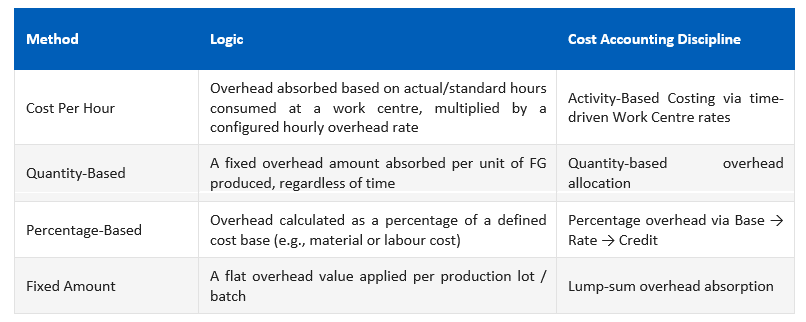
Each of these is configured at the intersection of Product and Work Center, meaning two products running through the same work center can absorb overhead completely differently if their cost structures demand it — exactly the flexibility a multi-product manufacturing plant needs.
A Worked Example (Illustrative)
To make this concrete: imagine a finishing work center configured with a Cost Per Hour overhead rate of ₹500/hour, reflecting its true indirect cost run-rate (power, depreciation, supervisory time).
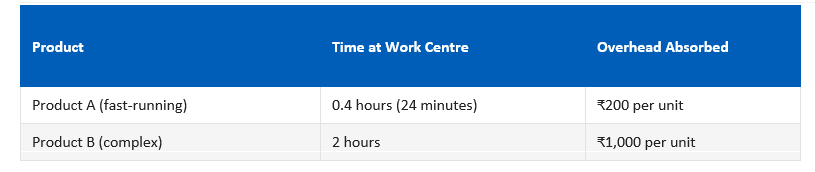
Under a flat, undifferentiated allocation, both products might have absorbed the same overhead per unit — understating Product B's true cost and overstating Product A's. With the engine's Cost Per Hour method, each product absorbs overhead in direct proportion to the resource it actually consumes — the way true cost accounting demands.
Before vs. After: What Changes on the Ground
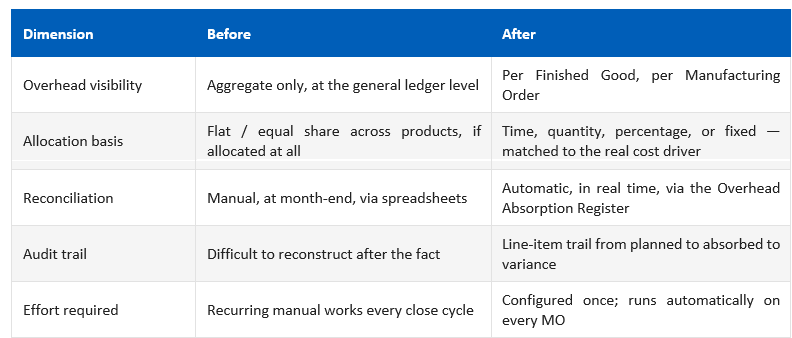
The clearest way to see the value of the Overhead Absorption Engine is to compare how overhead is handled before and after it's in place:
Common Pitfalls Without Proper Overhead Absorption
Manufacturers without a dedicated overhead absorption discipline commonly run into the same set of problems, whichever ERP they're on:
- Cross-subsidization — simple, fast-running products quietly subsidize the true cost of complex, slow-running ones sharing the same work center.
- Mispriced SKUs — without overhead allocated accurately, pricing and margin decisions are made on incomplete cost data.
- Month-end scramble — finance teams reconstruct overhead allocation manually in spreadsheets, often after the fact and inconsistently.
- Audit friction — without a register-level trail, auditors and finance leadership have no clean way to trace how overhead was allocated.
- Capacity blind spots — without visibility into which work centers are truly overhead-intensive, capacity and automation investment decisions are made on incomplete information.
The Overhead Absorption Register
The calculation engine alone wasn't enough. What makes this genuinely enterprise-grade is the Overhead Absorption Register Prixgen built alongside it — a dedicated reconciliation ledger, inspired by the same clearing discipline that makes GR/IR-style processes trustworthy to auditors.
Every time a Manufacturing Order is confirmed and overhead is rolled onto the FG, the Register captures:
- The planned overhead credited against the work center/cost center
- The absorbed overhead debited onto the Finished Good
- The variance between planned and actual absorption, surfaced automatically rather than discovered at month-end
This gives finance teams the same auditability they'd expect from a mature enterprise costing run — a clear, line-item trail of where every rupee of indirect cost went — without ever leaving Odoo, and without the multi-week configuration cycles traditional overhead costing setups typically demand.
How It Works, Step by Step
1. Configure — Each Work Center is set up with its overhead absorption method (Cost Per Hour, Quantity, Percentage, or Fixed Amount) and rate. Products can override the default method where their cost structure demands it.
2. Produce — A Manufacturing Order runs through the configured Work Center as normal — no extra steps for the shop floor, no new screens to learn.
3. Absorb — On MO confirmation, the engine automatically calculates overhead absorption based on actual or standard hours/quantity, and rolls it onto the Finished Good's cost, alongside material and labor.
4. Reconcile — The Overhead Absorption Register posts the credit (Work Center/Cost Center) and debit (Finished Good) legs, with any variance from plan surfaced immediately.
5. Report — Finance reviews planned vs. absorbed overhead at any time — not just at period close — giving real-time visibility into whether overhead rates need revisiting.
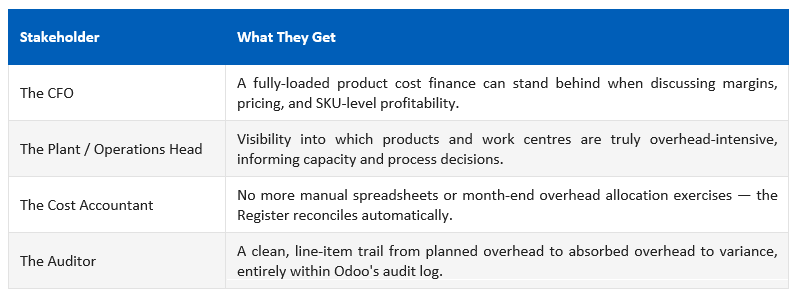
The Beauty of Odoo
Here's what makes this story worth telling: in traditional enterprise ERP platforms, achieving this level of overhead absorption sophistication means configuring costing rules, overhead keys, cost center planning cycles, and calculation templates — a process that routinely takes weeks of specialized configuration effort by expert consultants, on top of an already expensive license and implementation footprint.
Prixgen built the equivalent capability — activity-based, product-and-work-center-level overhead absorption with full reconciliation — as a native extension on Odoo's open ORM and modular architecture, in a fraction of that time. That's the beauty of Odoo: its architecture doesn't put a ceiling on what's possible — it invites a partner who genuinely understands both manufacturing cost accounting and Odoo engineering to build enterprise-grade financial rigor right into it.
This is precisely why Prixgen exists: to keep proving that manufacturers don't have to choose between an ERP that's fast and affordable to implement, and one that gives finance the rigor they've always wanted. With Odoo — and the right engineering partner — they can have both.
A Typical Rollout Timeline
Because the engine builds on Odoo's existing Manufacturing and Costing structures rather than replacing them, rollout is measured in weeks, not months:
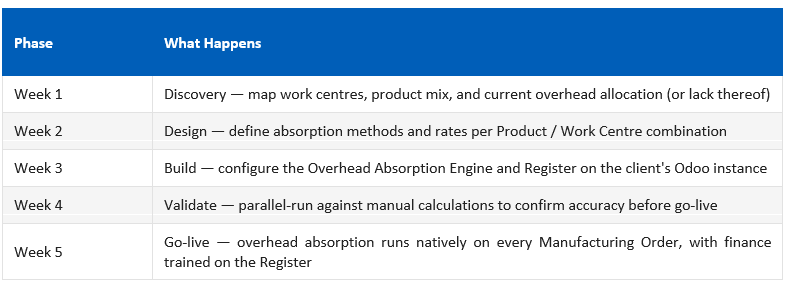
ILLUSTRATIVE: Actual timelines vary by the number of work centers, products, and the complexity of existing costing configuration — the above is a representative illustration, not a fixed quote.
Frequently Asked Questions
Does this require changes to how the shop floor works?
No. Manufacturing Orders are created and confirmed exactly as before — overhead absorption happens automatically in the background, with zero additional steps for shop floor users.
Can different products use different absorption methods on the same Work Center?
Yes. Because the method is configured at the intersection of Product and Work Center, two products sharing a resource can be set up completely differently based on what best reflects their true cost drivers.
What happens if overhead rates change during the year?
Rates can be updated at the Work Center level at any time; the Register captures the rate in effect at the time of each MO confirmation, preserving an accurate historical trail.
Does this replace standard Odoo costing?
No — it extends it. Material and labor costing continue to work exactly as Odoo natively calculates them; this engine adds the missing overhead layer on top, in the same MO Cost / Real Cost view finance and operations already use.
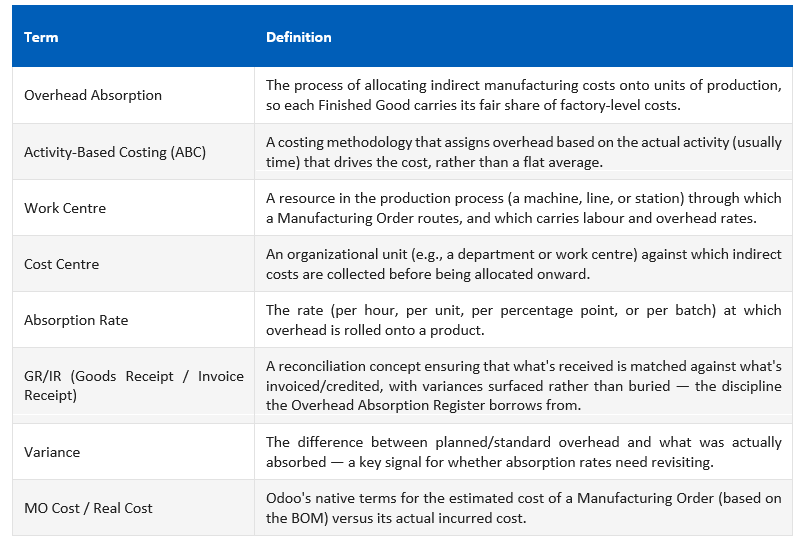
Glossary of Key Terms
Why This Matters for Growing Manufacturers
Manufacturers evaluating their ERP options no longer have to trade agility for costing rigor. Prixgen has now proven, in production, that Odoo can carry the same Activity-Based Costing discipline manufacturers have long valued — natively, in real time, and without the long implementation cycles that discipline used to require.
For manufacturers running multi-product, multi-work-center operations who want a true, fully-loaded product cost — material, labor, and overhead, together — this is what's now possible on Odoo.
"Prixgen Tech Solutions Pvt. Ltd.
"Odoo Gold Partner with 44+ certified Odoo professionals, delivering ERP transformation across India, the Middle East, and Southeast Asia. Prixgen has engineered proprietary Odoo-native platforms — from Import Duty Intelligence to Manufacturing Overhead Absorption — that bring enterprise-grade financial rigor to growing manufacturers.
"Want to see what a fully-loaded product cost looks like on your shop floor?
"sales@prixgen.com|www.prixgen.com