From Polymer to Pipe:
Building a Connected Operating Model
Walk through any PVC pipe plant and the physical flow is easy to follow from resin to finished pipe. But information flow is fragmented across six operational silos. What we have learned implementing ERP for more than 10 PVC and polymer manufacturers is that the next competitive advantage is visibility, not just capacity.
Which of the following have had the biggest impact on your organization's transformation successes?
If your transformation projects continue to succeed, what impact would each result have?
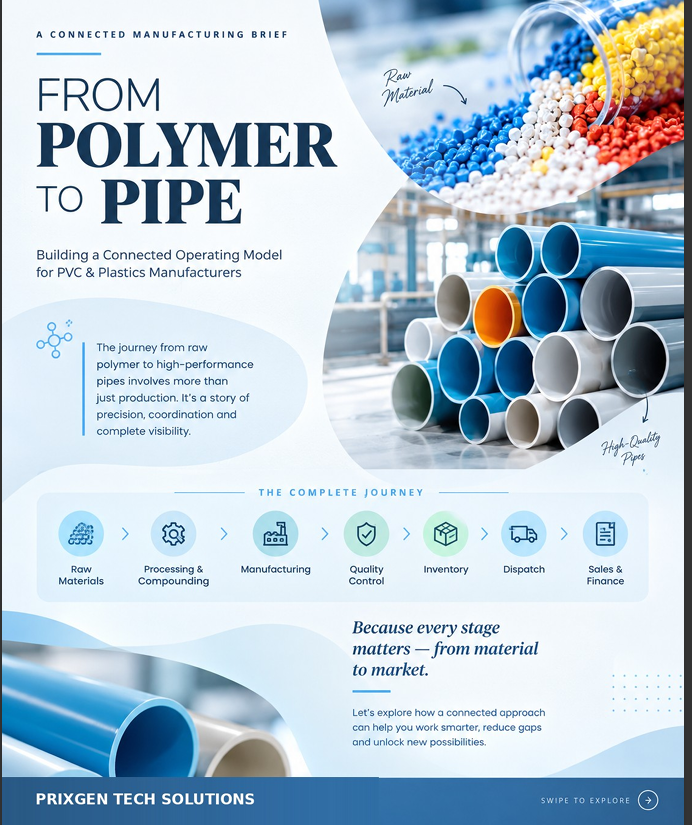
From Polymer to Pipe:
How Connected ERP Changes PVC & HDPE Manufacturing
Watch how a unified digital operating model eliminates disconnected operational silos — bridging recipe compounding, extrusion line telemetry, and financial traceability into a single source of truth.
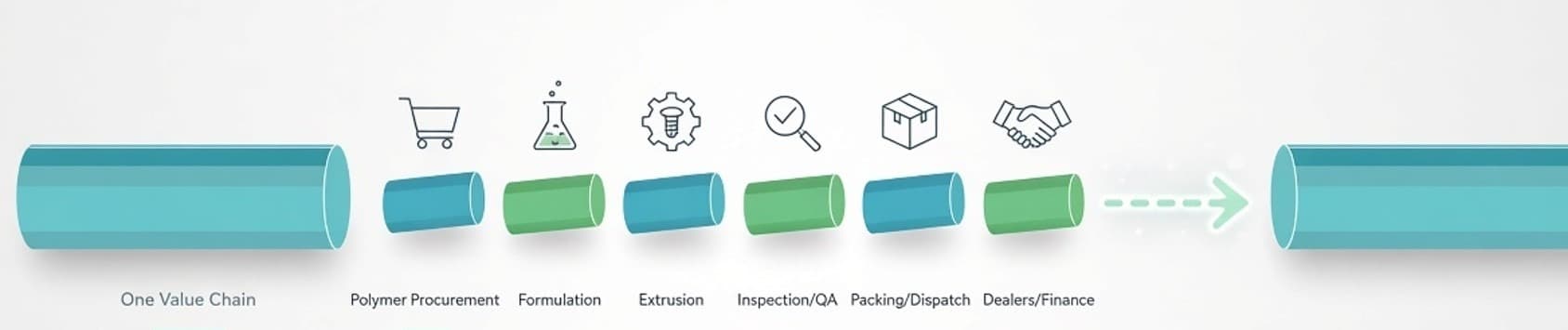
One Value Chain, Six Disconnected Systems
Procurement, formulation, production, quality, inventory, and finance are usually owned by six different teams, tracked in six different systems, and reconciled on six different schedules. Yet for a PVC manufacturer, this isn't six businesses — it is one continuous value chain.

Procurement
Resin price volatility tracked in isolated supplier spreadsheets
Formulation
Recipe batching variance and unrecorded regrind blending
Production
Extrusion line stoppages and changeovers missing from ERP
Quality
Hydrostatic and wall-thickness tests logged on paper clipboards
Inventory
Physical yard stock vs system mismatches across pipe classes
Finance
Actual production scrap costs discovered weeks late at month-end
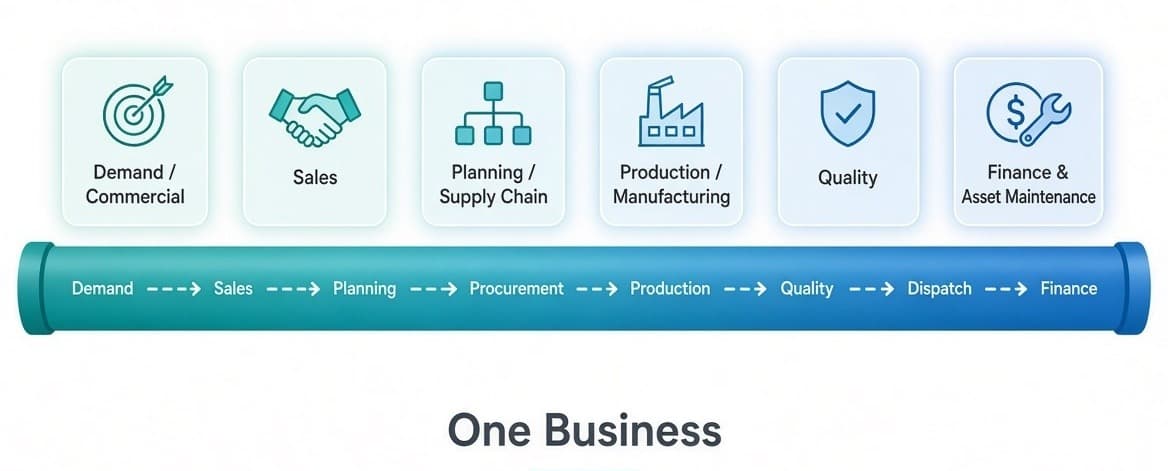
“A pipe manufacturer does not run six businesses. It runs one business, expressed through six operational lenses. Your systems should reflect that.”
Five Industry Shifts Manufacturers Can't Ignore
Five structural shifts are reshaping the plastics and pipe manufacturing industry, and none of them is optional or reversible.
Demand Volatility & Forecasting Pressure
Raw resin and finished pipe markets move significantly faster than periodic, manually reconciled planning cycles can accommodate.
Requires real-time MRP linked to live resin pricing engines.
SKU & Variant Explosion
Combinations of diameter, pressure class, SDR ratings, and color stripes multiply master-data complexity exponentially.
Demands automated matrix BOMs and variant configuration.
Rising Traceability Expectations
Infrastructure projects and strict standards require an unbroken, defensible batch-to-dispatch digital audit trail.
Requires end-to-end 10-link lot serialization from resin silo to dispatch.
Margin Pressure on Commodity Resin
Razor-thin margins leave zero tolerance for unrecorded wall-thickness over-give, cold-start scrap, or unmanaged regrind.
Shifts profitability focus directly to scrap reclamation and precision weighing.
From Capacity to Visibility & Control
Competitive advantage is no longer just how many tons an extrusion line can pump out, but how accurately management can steer the plant.
Transforms shop-floor telemetry into executive operating advantage.
The manufacturing advantage is shifting from capacity alone to visibility, responsiveness and control.
Seven Fault Lines in Modern Pipe Manufacturing
Most operational breakdowns in pipe manufacturing trace back to one of seven recurring fault lines between shop-floor physics and enterprise systems.
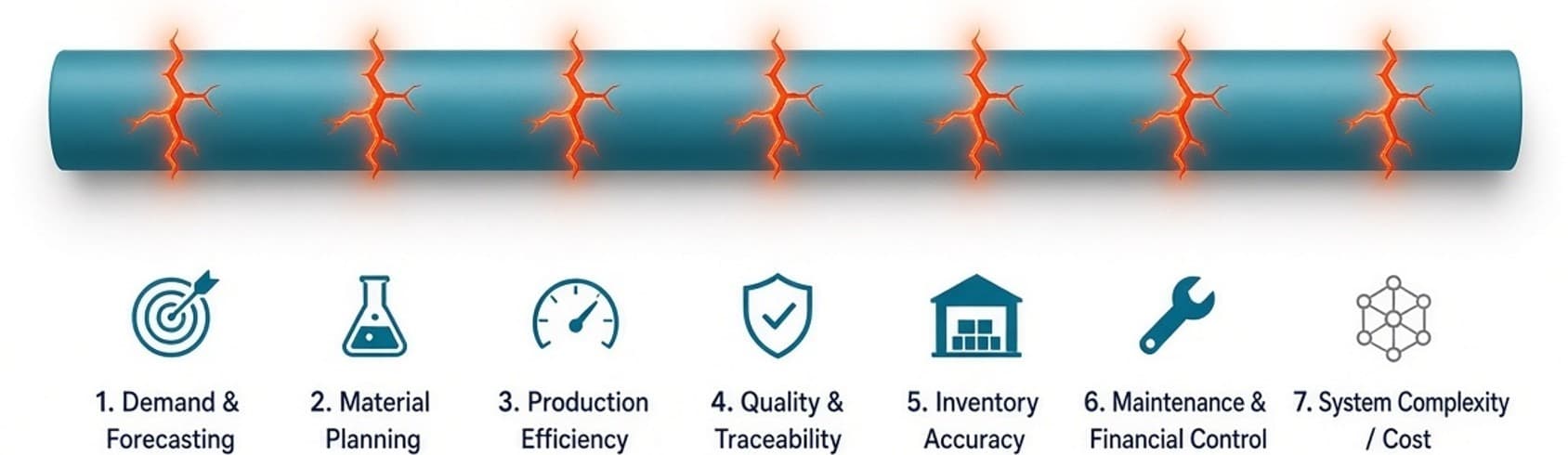
Demand & Forecasting Misalignment
Production schedules based on stale monthly forecasts lead to emergency changeovers and stockouts.
Excess working capital locked in slow-moving pipe diameters while high-velocity SKUs starve.
Eliminates manual re-entry by synchronizing line metrics, weighing buffers, recipe limits, and accounting into a unified real-time transaction ledger.
From Polymer to Finished Pipe: The 10-Step Journey
A finished, dispatch-ready pipe passes through ten distinct stages. Upstream control points capture batch identity; downstream control points capture what shipped, to whom, and in what condition.
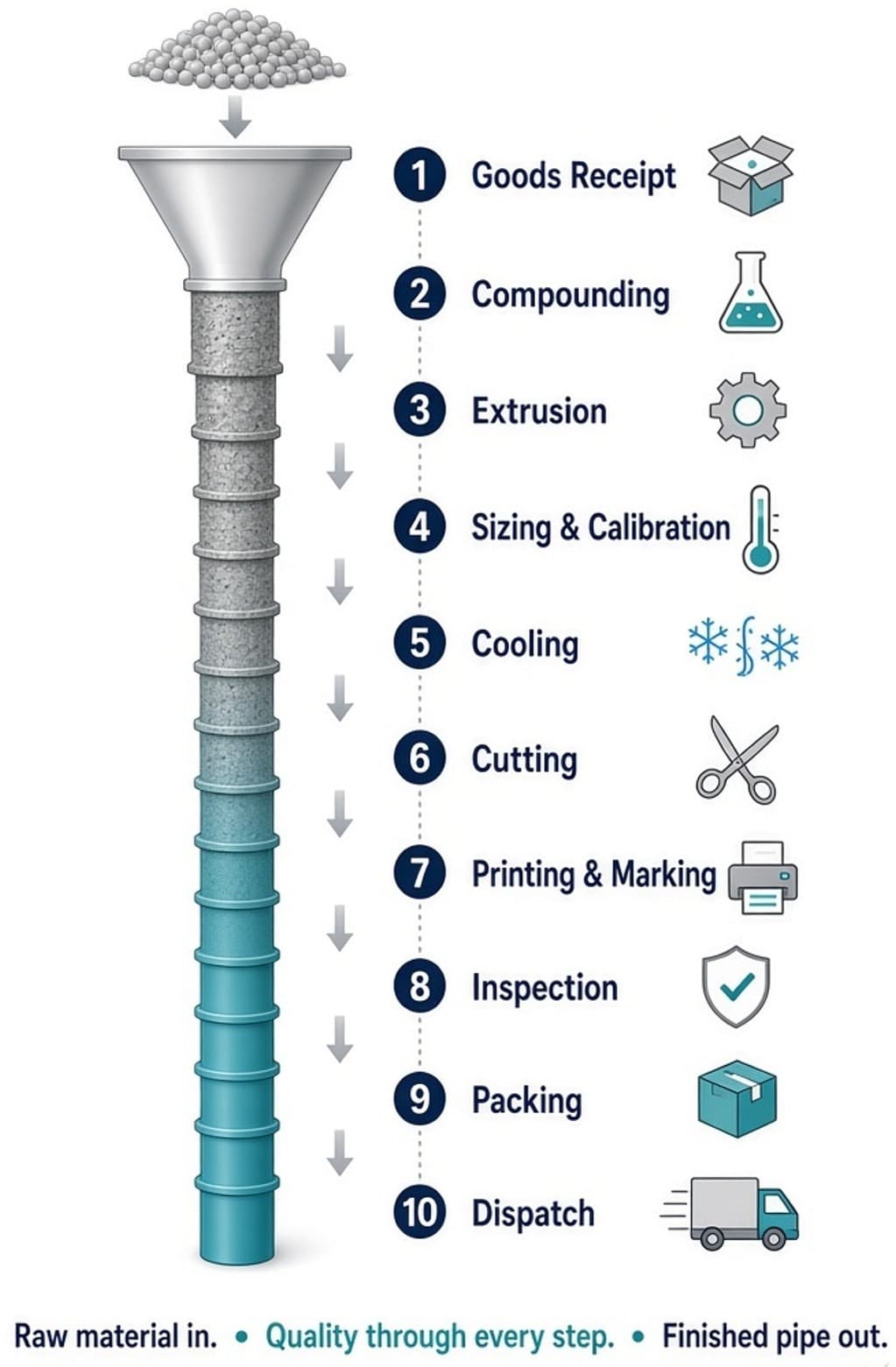
Step 01: Goods Receipt
Resin lot inspection, bulk density check, weighbridge gross/tare validation, and automated silo allocation with supplier COA digital verification.
Automated Gross-Tare net weight deduction, Supplier COA attachment, and direct Silo Bin lot creation upon gate entry.
Two Hidden Costs: Shooting Waste & the Wall-Thickness Paradox
Two costs quietly compound as a product range grows, and neither is tracked as its own line item by default.
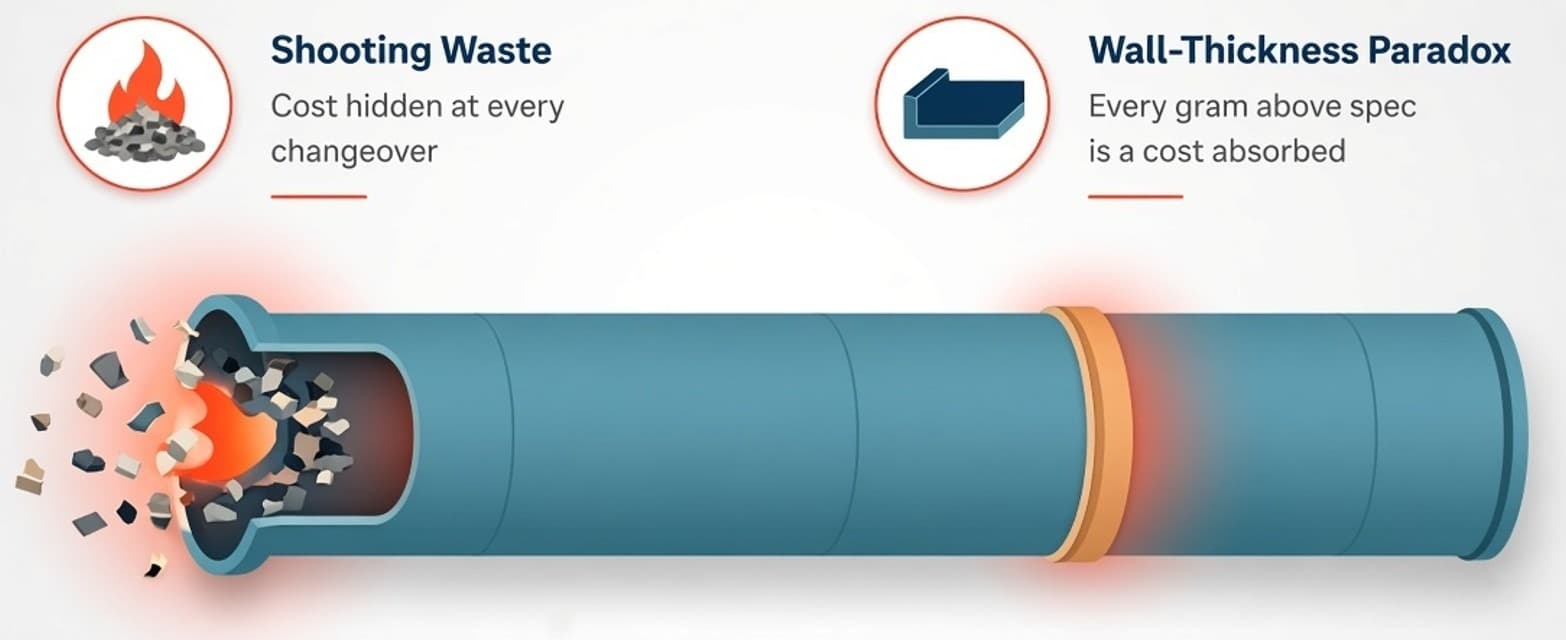
1. Shooting Waste (Purge Loss)
Every colour or diameter change forces the extruder to re-stabilise. Material produced during that stabilization window cannot be sold as first-quality, and the cost scales directly with the number of changeovers rather than production volume.
Sequencing production runs dynamically by diameter/color matrix and routing scrap through an automated closed reclaim loop turns this into a measured KPI instead of a buried variance.
2. The Wall-Thickness Paradox
A pipe that is too thin fails quality control and gets rejected — but one that is too thick still passes inspection, quietly absorbing extra grams of costly polymer resin with every single meter produced above target specification.
Continuous ultrasonic condition-monitoring tracks tool and die wear, flagging replacement requirements and automatic calibration before excess resin is burned.
Neither cost is tracked as its own line item by default. In a commodity-resin business, recovering even a small percentage of overweight and changeover scrap goes straight to the bottom line.
Traceability: One Question, Ten Links in the Chain
When a customer reports a failed pipe, answering “where did this come from?” requires ten linked records: supplier batch, raw material lot, material issue, production order, machine/shift, production batch, inspection result, finished goods lot, warehouse location, and customer dispatch.
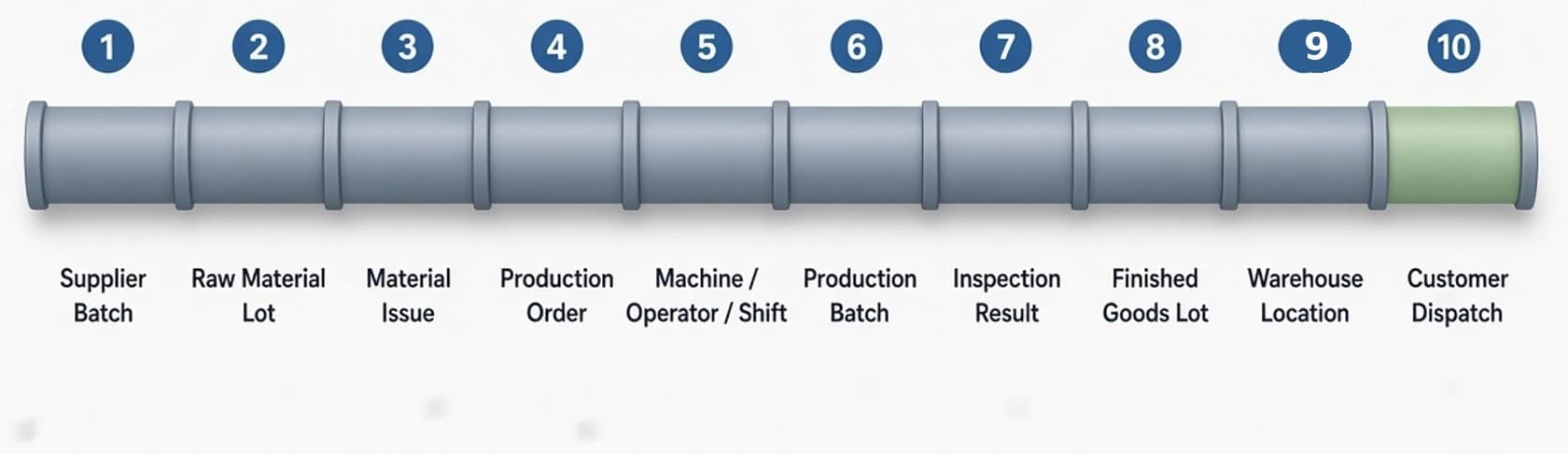
Supplier Batch
Polymer resin supplier COA & delivery invoice
From Stock Visibility to Inventory Intelligence
Knowing a stock quantity isn't the same as being able to plan against it. A trustworthy stock figure must be accurate on five dimensions at once: quantity, batch, location, allocation, and status.
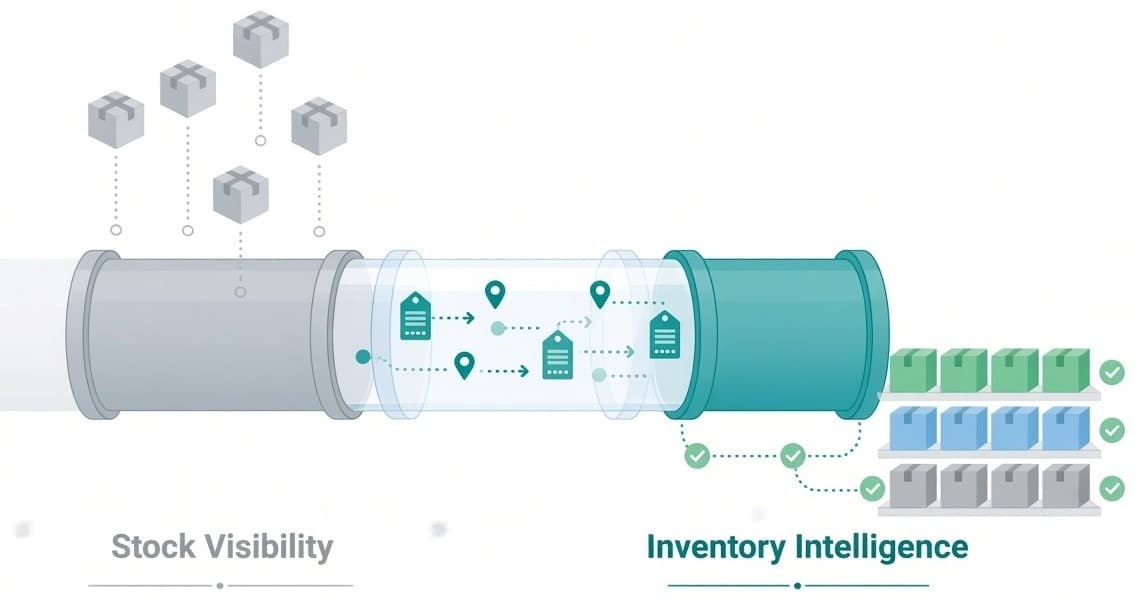
Quantity
Exact piece count, bundled length & net weight via scale sync.
Batch & Lot
Resin blend formulation date, color run & extruder line ID.
Location
Precise silo, buffer zone, yard bay, or rack coordinate.
Allocation
Hard-locked to confirmed dealer orders vs free unallocated stock.
QC Status
Raw quarantined, tested first-choice, secondary, or reclaim.
If your inventory report cannot tell you which batch a bundle belongs to and which customer it is reserved for, it is not really an inventory figure. It is an estimate.
From Reactive to Predictive Maintenance
Extruders, haul-offs, cutters and moulds are the heart of the plant. Maintenance maturity moves through three distinct stages — trading firefighting for foresight and delivering less unplanned downtime.
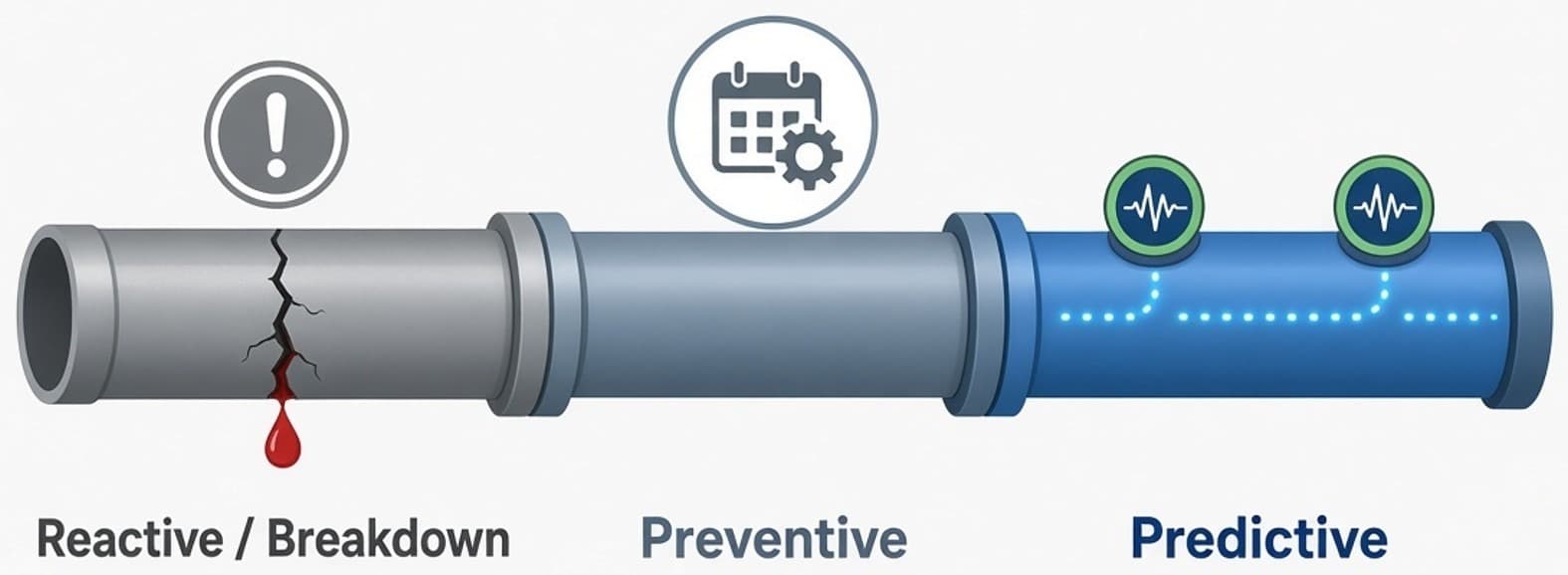
Reactive Maintenance
Emergency repairs after equipment stoppage. High rush-part freight spend and extended lost extrusion hours.
Preventive Maintenance
Calendar-based servicing routines and scheduled downtime for screw cleaning and die maintenance.
Predictive Maintenance
Machine integration captures runtime directly from equipment and triggers maintenance on actual run hours rather than elapsed calendar time.
Overall Equipment Effectiveness (OEE)
Availability × Performance × Quality gives management a common language for line performance.
The 5-Layer Connected Manufacturing Operating Model
Bringing this together, a modern PVC operation operates in five distinct layers. Data generated at lower layers becomes the raw material for the layers above.
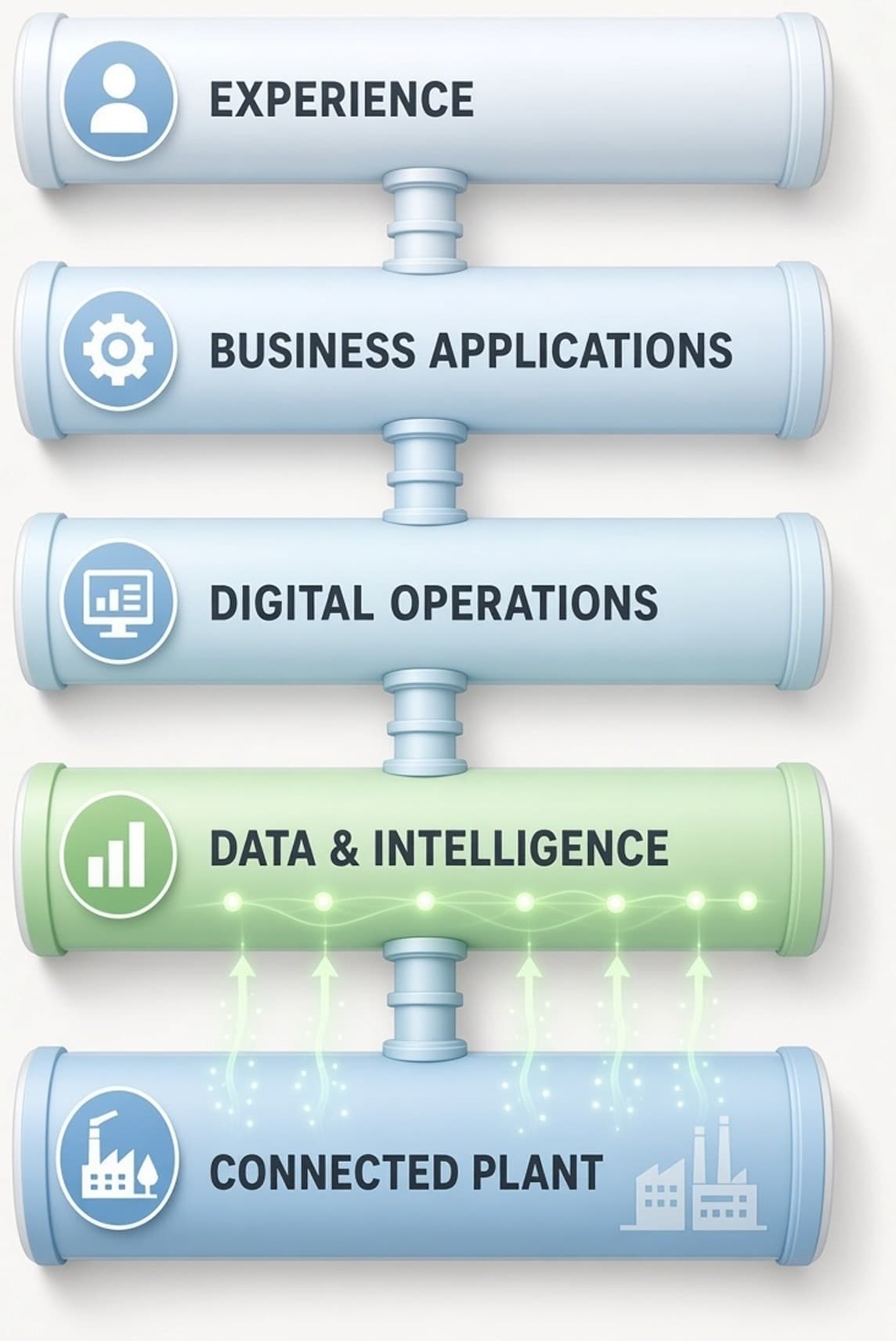
Experience & Dealer Portal
Dashboards, mobile apps and portals for management, shop-floor teams, dealers, and customers.
Business Applications (Odoo Core)
ERP processes for sales, purchase, finance, and HR that consume the same data without re-keying.
Digital Operations & Workflow
Planning, production, quality, inventory, and maintenance running on shared, real-time data.
Data & Intelligence Layer
A single, clean data foundation that turns raw plant signals into usable operational intelligence.
Connected Plant (Shop Floor)
Machines, weighing scales, and sensors that record what actually happens on the line.
What Should Management Measure? The Scorecard
The value of this scorecard is not just the list of metrics. It is having every metric derived from the same transactions that run the business — refreshed continuously instead of assembled by hand.
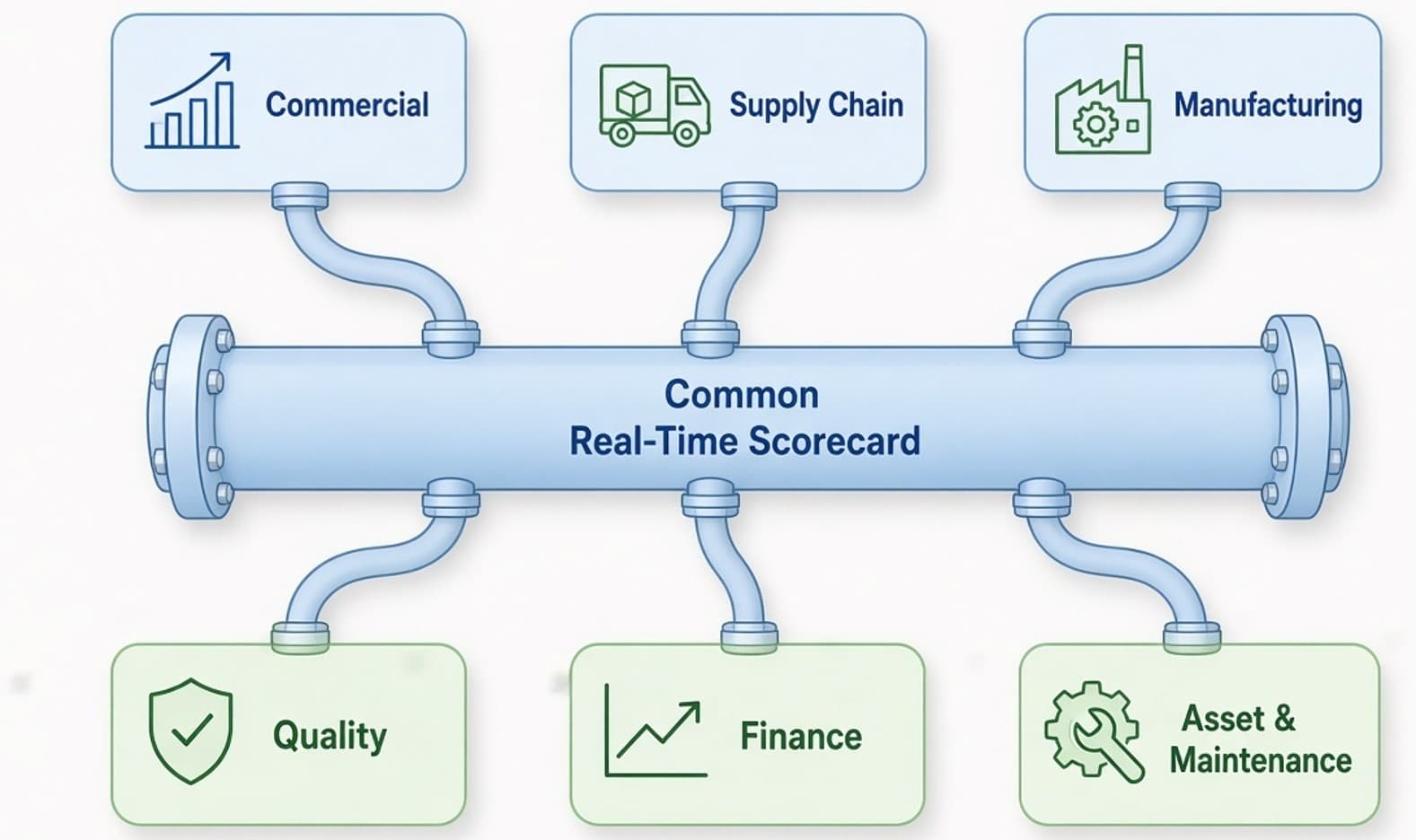
Order Fill Rate (OTIF)
Complete on-time dealer deliveries
Quote-to-Order Cycle
Automated dynamic resin pricing speed
Revenue Mix by Class
High-margin fittings vs commodity pipes
Lessons From 10+ PVC Implementations
Across our PVC and polymer manufacturing projects — from single-plant pipe makers to multi-unit industrial groups — a few hard-won lessons have proven true every time.
Get Product Master Data Right First
A clean structure for diameter, pressure class, wall thickness, colour, and length prevents most downstream confusion in planning, pricing, and stock.
Model the Process as it Really Runs
Continuous extrusion, weight-based consumption, regrind and reclaim loops need to be reflected faithfully, not forced into a generic discrete-manufacturing template.
Capture Data at Source
Production, scrap, and weight recorded directly at the extrusion line, by shift, are far more reliable than figures reconstructed at the end of the day.
Connect Quality to Batches from Day One
Retrofitting digital traceability later is significantly harder and more disruptive than designing digital batch-locking in from day one.
Involve Finance Early
Our in-house Chartered Accountants and manufacturing finance consultants ensure costing, variance, and month-end closing work for plant operations, not just for auditors.
Phase Sensibly
Finance, inventory, and production core usually come first; advanced planning, predictive maintenance, and direct machine integration follow once the foundation is stable.
Never Subcontract Execution
Because Prixgen never subcontracts project work, the same in-house team that designs your manufacturing architecture is the one that configures, tests, and supports it.
Frequently Asked Questions
Common questions from plant promoters and operations directors evaluating ERP for plastics and pipe manufacturing.
From Polymer to Pipe: Building a Connected Operating Model
The complete engineering executive whitepaper for PVC and plastics manufacturers — detailing recipe drift controls, ultrasonic sensor integrations, and closed-loop scrap purge accounting.
10-Link Traceability Matrix
Audit chain mapping resin supplier COAs to customer dispatch lots.
Wall-Thickness Over-Give Math
Formulas to quantify and eliminate hidden resin giveaways.
Purge Waste Closed-Loop Model
Automated MRP regrind calculations for cold-start scrap reclaim.
5-Layer Odoo IIoT Blueprint
Shop-floor extruder PLC integration into financial ledgers.
From Polymer to Pipe: Building a Connected Operating Model
Operational guide for PVC and plastics manufacturers modernizing plant systems and traceability.
Can you connect the journey from polymer to pipe?
Material, movement, transformation, money and people: a PVC business runs well when all five are visible in one place. If you would like to understand where the biggest visibility gaps are in your own operation, our manufacturing consultants would be happy to walk your plant with you.
Request a Consultation
Share your plant details to connect with our Odoo & PVC manufacturing architects.