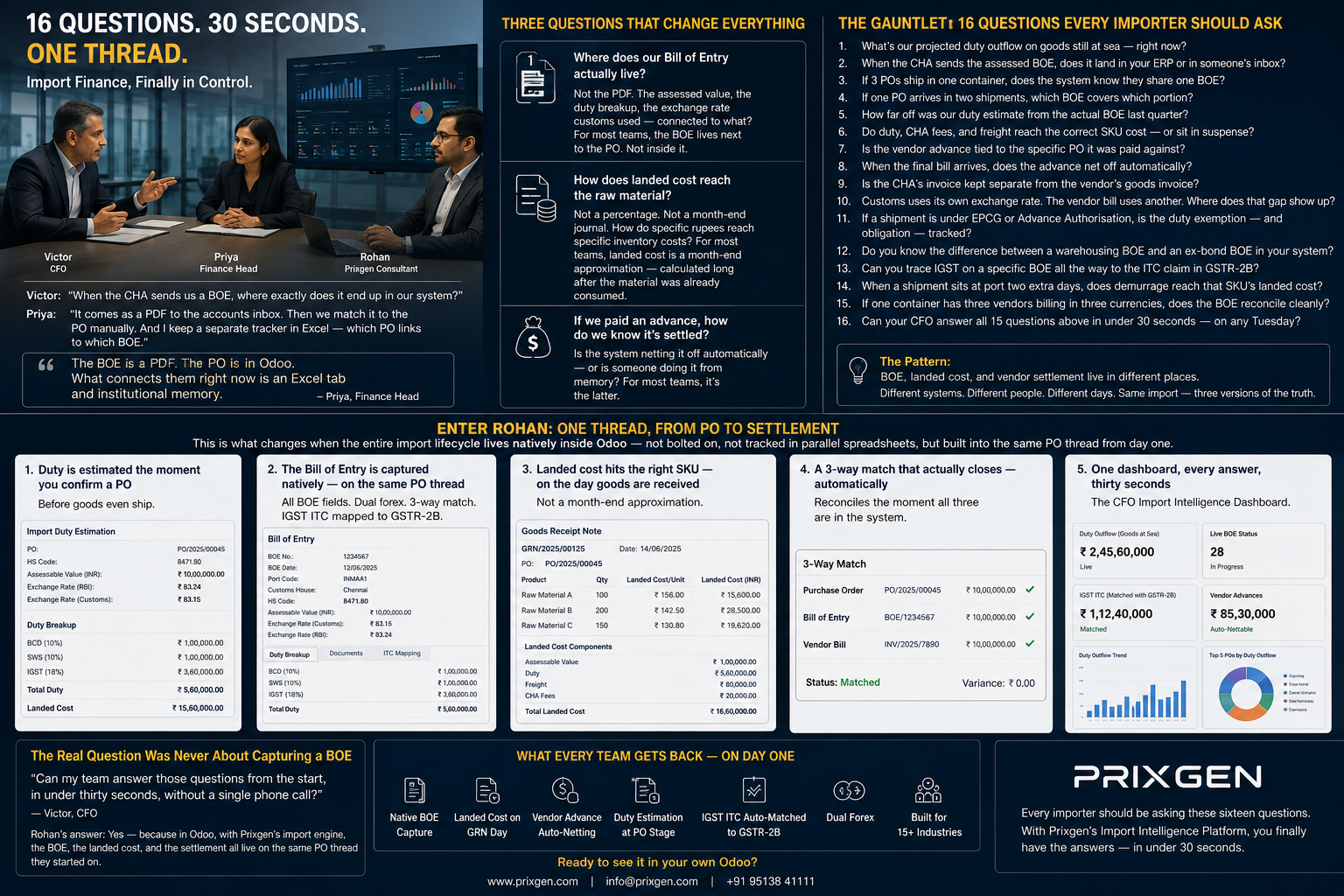
It's a Monday morning finance review. Victor, the CFO, leans forward and asks Priya, his Finance Head, one simple question:
"“When the CHA sends us a BOE, where exactly does it end up in our system?”
Priya doesn't hesitate — she knows this process cold.
"“It comes as a PDF to the accounts inbox. Then we match it to the PO manually. And I keep a separate tracker in Excel — which PO links to which BOE.”
The room goes quiet. Not because the answer is wrong. Because it's exactly right — and that's the problem. It's the answer almost every importer gives.
Three Questions That Change Everything
Victor doesn't stop there. He asks three more:
1. Where does our Bill of Entry actually live?
Not the PDF. The assessed value, the duty breakup, the exchange rate customs used — connected to what? For most teams, the BOE lives next to the PO. Not inside it.
2. How does landed cost reach the raw material?
Not a percentage. Not a month-end journal. How do specific rupees reach specific inventory costs? For most teams, landed cost is a month-end approximation — calculated long after the material was already consumed.
3. If we paid an advance, how do we know it's settled?
Is the system netting it off automatically — or is someone doing it from memory? For most teams, it's the latter.
None of these are trick questions. They simply reveal exactly where import finance gets complicated — the moment customs hands your Bill of Entry back to you.
"“The BOE is a PDF. The PO is in Odoo. And what connects them right now is an Excel tab and institutional memory.” — Priya, Finance Head
The Gauntlet: 16 Questions Every Importer Should Ask
Victor pulls out a longer list. Sixteen questions. How many can your finance team answer in 30 seconds?
1. What's our projected duty outflow on goods still at sea — right now?
2. When the CHA sends the assessed BOE, does it land in your ERP or in someone's inbox?
3. If 3 POs ship in one container, does the system know they share one BOE?
4. If one PO arrives in two shipments, which BOE covers which portion?
5. How far off was our duty estimate from the actual BOE last quarter?
6. Do duty, CHA fees, and freight reach the correct SKU cost — or sit in suspense?
7. Is the vendor advance tied to the specific PO it was paid against?
8. When the final bill arrives, does the advance net off automatically?
9. Is the CHA's invoice kept separate from the vendor's goods invoice?
10. Customs uses its own exchange rate. The vendor bill uses another. Where does that gap show up?
11. If a shipment is under EPCG or Advance Authorisation, is the duty exemption — and obligation — tracked?
12. Do you know the difference between a warehousing BOE and an ex-bond BOE in your system?
13. Can you trace IGST on a specific BOE all the way to the ITC claim in GSTR-2B?
14. When a shipment sits at port two extra days, does demurrage reach that SKU's landed cost?
15. If one container has three vendors billing in three currencies, does the BOE reconcile cleanly?
16. Can your CFO answer all 15 questions above in under 30 seconds — on any Tuesday?
Most finance teams get through three or four before reaching for a phone, an inbox search, or an Excel tab.
Victor Sees the Pattern
Every one of those sixteen questions traces back to the same root cause: the BOE, the landed cost, and the vendor settlement all live in different places.
—BOE in one place — a PDF in an inbox or shared drive, not linked to the PO.
—Landed cost elsewhere — a month-end journal entry, approximate and retrospective.
—Vendor settlement elsewhere — advance netting depending on someone's memory, not the system.
Different systems. Different people. Different days. Same import — three versions of the truth.
Enter Rohan: One Thread, From PO to Settlement
This is where Prixgen comes in. Rohan, a Prixgen consultant, sits down with Victor and Priya's team and shows them what changes when the entire import lifecycle lives natively inside Odoo — not bolted on, not tracked in parallel spreadsheets, but built into the same PO thread from day one.
Here's what that looks like in practice.
1. Duty is estimated the moment you confirm a PO — before goods even ship
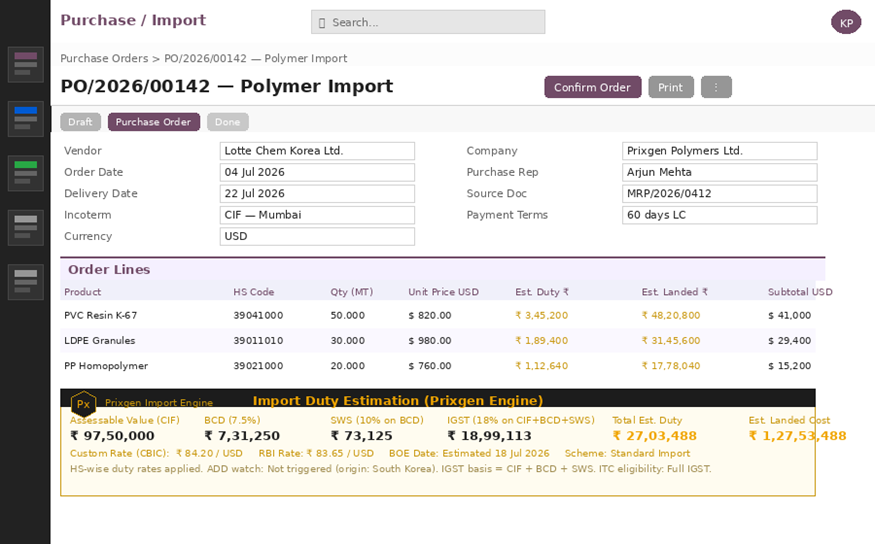
The Prixgen Import Duty Estimation Panel inside Odoo — BCD, SWS, IGST, customs rate, and landed cost, visible at PO stage.
No more waiting for the Bill of Entry to know what a shipment is going to cost. The moment a PO is confirmed, Prixgen's engine estimates the full duty outflow against it.
2. The Bill of Entry is captured natively — on the same PO thread
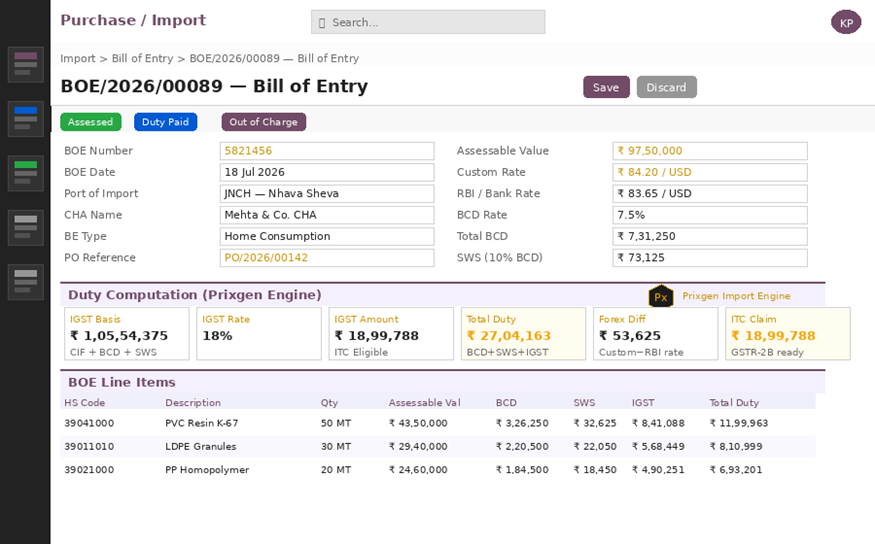
Every BOE field — number, date, port, HS code, assessable value, both forex rates — captured on the same PO thread. Dual forex, 3-way match, and IGST ITC mapped straight to GSTR-2B.
Every field from the actual Bill of Entry — assessable value, duty breakup, the exchange rate customs used versus the RBI rate — lives right where the PO already is. No PDF, no separate tracker.
3. Landed cost hits the right SKU — on the day goods are received, not month-end
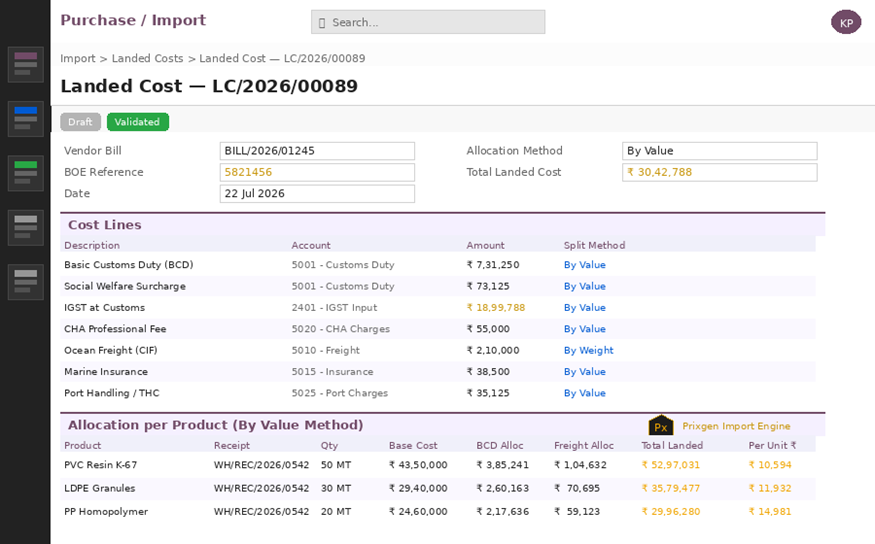
Landed cost allocated to each SKU on GRN day — not a month-end approximation, in line with Ind AS 2 inventory valuation.
Duty, CHA fees, and freight get allocated to the exact inventory line they belong to, the day goods are received — not as a percentage guess weeks later.
4. A 3-way match that actually closes — automatically
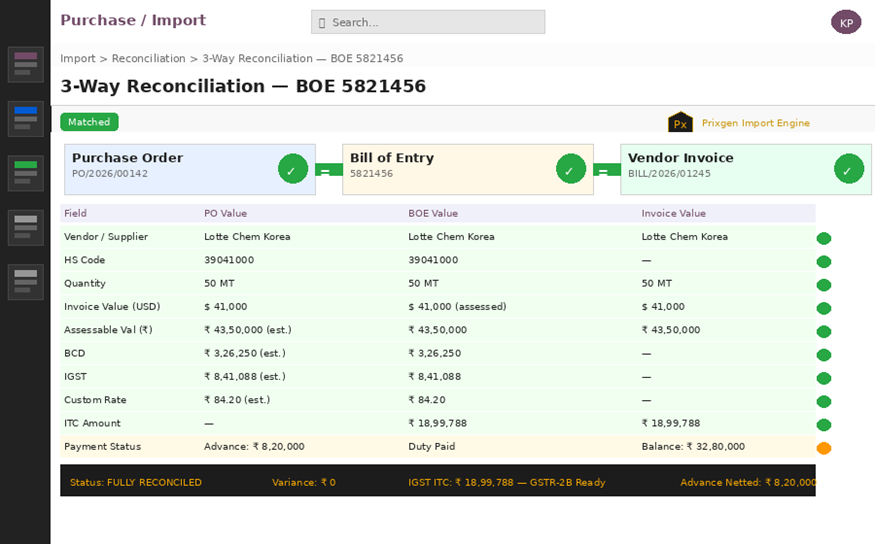
The reconciliation that usually eats a finance analyst's afternoon runs on its own, the moment all three documents are in the system.
5. One dashboard, every answer, thirty seconds
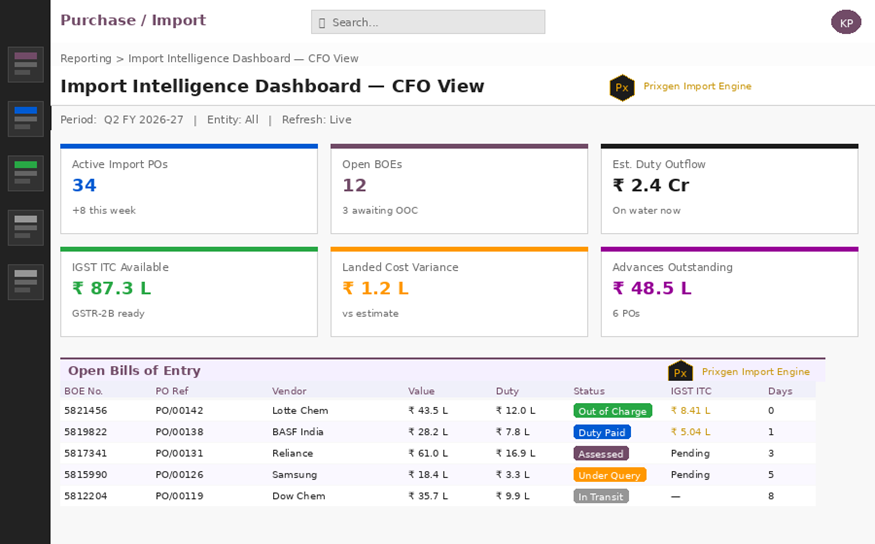
The CFO Import Intelligence Dashboard — duty outflow on goods still at sea, live BOE status, GSTR-2B-matched IGST ITC, and every vendor advance with its PO linkage, all in one place.
This is the screen that answers Victor's original sixteen questions — without a single phone call to accounts.
The Real Question Was Never About Capturing a BOE
Victor asks it plainly:
"“Can my team answer those questions from the start, in under thirty seconds, without a single phone call?”
Rohan's answer: yes — because in Odoo, with Prixgen's import engine, the BOE, the landed cost, and the settlement all live on the same PO thread they started on.
The real question was never “how do we capture a BOE.” It's this:
"Does your ERP store import data — or does it actually run your import process?
That's the difference Prixgen builds into Odoo.
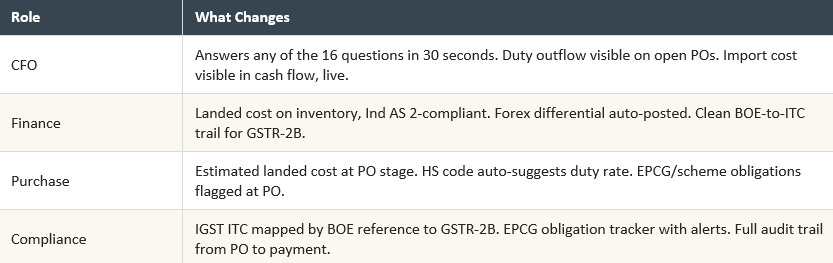
What Every Team Gets Back — On Day One
Ready to see it in your own Odoo?
"Every importer should be asking these sixteen questions. With Prixgen's Import Intelligence Platform, you finally have the answers — in under 30 seconds.
Native BOE Capture ·Landed Cost on GRN Day ·Vendor Advance Auto-Netting ·Duty Estimation at PO Stage ·IGST ITC Auto-Matched to GSTR-2B ·Dual Forex ·Built for 15+ Industries