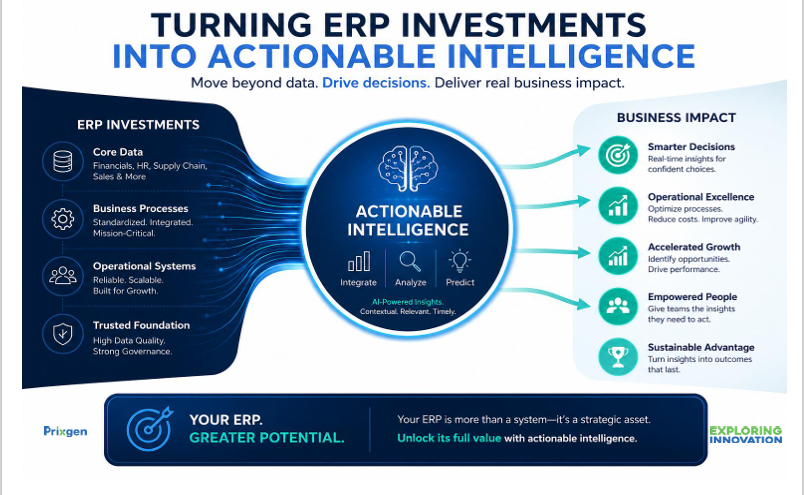
Turning ERP Investments into Actionable Intelligence
Organizations invest significant time, capital, and effort into ERP implementations with the expectation of gaining a unified view of operations, finance, inventory, customers, and performance. Yet many leadership teams find themselves asking the same question months after go-live:
"Why do we still struggle to get accurate and timely information?"
The answer often has little to do with dashboards, analytics tools, or reporting software. More often, the challenge originates from inconsistent business processes, fragmented data structures, and excessive customization carried over from legacy systems.
True business visibility is not achieved by building more reports. It is achieved by creating a consistent operational foundation that generates trustworthy data from the very beginning.
The Visibility Gap Most ERP Projects Overlook
When organizations modernize their ERP platforms, there is a natural tendency to replicate existing processes exactly as they function today. While this may appear to reduce change management challenges, it frequently transfers old inefficiencies into a new system.
As a result:
- Departments maintain different definitions of the same data.
- Reporting structures become difficult to reconcile.
- Manual workarounds continue to exist.
- Management receives conflicting information from different teams.
The ERP becomes operational, but not transformational.
Business leaders expect a single source of truth. Instead, they often receive multiple versions of the truth.
What Are ERP Best Practice Templates?
Modern ERP platforms are built upon decades of implementation experience across thousands of organizations worldwide.
These experiences have enabled software vendors to develop pre-designed business processes, workflows, approval structures, financial frameworks, and reporting models that reflect proven operational practices.
Examples include:
Finance
- Standard chart of accounts structures
- Automated approval workflows
- Budget controls
- Multi-company accounting frameworks
Sales
- Opportunity management processes
- Quotation approval hierarchies
- Customer lifecycle tracking
Procurement
- Purchase request workflows
- Vendor evaluation models
- Three-way matching controls
Manufacturing
- Production planning standards
- Bill of Materials structures
- Inventory valuation methodologies
Human Resources
- Employee onboarding processes
- Leave management workflows
- Performance review cycles
Rather than designing every process from scratch, organizations can leverage these established frameworks and adapt them only where genuine business differentiation exists.
Why Standardized Processes Produce Better Data
Data quality is rarely a technology problem.
It is usually a process problem.
When different teams follow different procedures for entering, approving, and managing information, reporting becomes unreliable regardless of how advanced the ERP platform may be.
Standardized workflows create:
Consistent Data Entry
Employees follow common procedures across departments, reducing duplication and human error.
Improved Accountability
Clearly defined responsibilities ensure ownership of transactions and approvals.
Reliable Reporting Structures
Management reports are generated from a common data model instead of disconnected spreadsheets and manual consolidations.
Faster Decision-Making
Executives spend less time validating information and more time acting on insights.
The Hidden Cost of Over-Customization
Customization is often necessary. However, excessive customization can create long-term challenges that outweigh short-term convenience.
Common consequences include:
Increased Complexity
Every custom workflow introduces additional maintenance and testing requirements.
Difficult Upgrades
Future ERP upgrades become slower, riskier, and more expensive.
Fragmented Reporting
Custom fields and unique processes can create reporting inconsistencies across business units.
Knowledge Dependency
Organizations become dependent on a small group of individuals who understand custom logic and configurations.
Over time, what was initially considered flexibility may become technical debt.
Where Customization Truly Adds Value
Not every process should be standardized.
Leading organizations distinguish between:
Strategic Processes
Activities that create competitive advantage and differentiate the business.
Examples:
- Proprietary manufacturing methods
- Unique pricing models
- Specialized service delivery workflows
- Industry-specific compliance requirements
These areas may justify customization.
Administrative Processes
Activities that support operations but do not differentiate the organization.
Examples:
- Purchase approvals
- Expense management
- Vendor onboarding
- General accounting procedures
These processes typically benefit from adopting proven ERP standards.
The goal is not to eliminate customization. The goal is to apply it strategically.
The Long-Term Benefits of ERP Best Practices
Organizations that embrace standard ERP frameworks often experience benefits that extend far beyond implementation.
Better Executive Visibility
Leaders gain access to reliable operational and financial information.
Lower Total Cost of Ownership
Reduced customization leads to lower support and maintenance costs.
Faster User Adoption
Employees learn standardized workflows more quickly.
Easier Expansion
New locations, subsidiaries, and business units can be integrated using consistent structures.
Improved Compliance
Built-in controls simplify audit preparation and regulatory reporting.
Scalable Growth
Business processes remain sustainable as transaction volumes increase.
From Data Collection to Business Intelligence
The most successful ERP implementations do not focus exclusively on software deployment.
They focus on creating a disciplined operating model that generates accurate, consistent, and meaningful data.
Dashboards, analytics platforms, and AI-driven insights are only as effective as the information feeding them.
When organizations establish standardized processes, common data structures, and governance-driven workflows, reporting naturally becomes more accurate, more timely, and more actionable.
The result is not simply a better ERP system.
It is a business that can make faster decisions, respond to market changes more effectively, and operate with greater confidence.
Final Thoughts
Many ERP projects promise visibility. Few achieve it immediately.
The organizations that succeed understand a fundamental principle:
"Visibility is not created by reports. It is created by disciplined processes.
By adopting proven ERP best practices where appropriate and customizing only where strategic value exists, businesses can build a foundation of trusted data that supports growth, governance, and informed decision-making for years to come.
The journey to better reporting begins long before the first dashboard is built. It begins with the way the business chooses to operate.