CostofProduction:TheCompleteGuidetotheFormula,CostTypesandGettingYourTrueUnitCostwithERP
Cost of Production: The Complete Guide to the Formula, Cost Types and Getting Your True Unit Cost with ERP
A definitive handbook for CXOs, finance heads, plant heads, and ERP owners on escaping the margin illusion and securing real-time unit economics.
Some years ago I sat across the table from the managing director of a mid-sized manufacturer who told me, with complete confidence, that his flagship product earned a 14% margin. His accountant agreed. His sales team priced every quote on that number.
When we finished mapping his actual material consumption, scrap, machine time, and overheads during the ERP blueprint, the real margin on that product was a little over 6%. Nobody had been dishonest. The cost sheet had simply been built on a standard formulation from three years earlier, an overhead rate nobody had revisited, and a scrap figure that existed only on paper.
"In 23 years of implementing and consulting on ERP across PVC, polymer, paints, chemicals, food processing, dairy, engineering, furniture and many other industries, I have found that most manufacturers know their selling price to the rupee but know their cost of production only approximately. And in a business where raw material can be 70–80% of the cost, ‘approximately’ is where the profit disappears."
This guide explains what cost of production really includes, the formula and its variations, the different types of cost and how each behaves, two fully worked examples from the shop floor, and the practical levers that bring the number down. Throughout, I will point out where an ERP system earns its keep — and where implementations commonly go wrong.
Five Fundamentals of Modern Production Costing
What Is Cost of Production? (Works / Factory Cost)
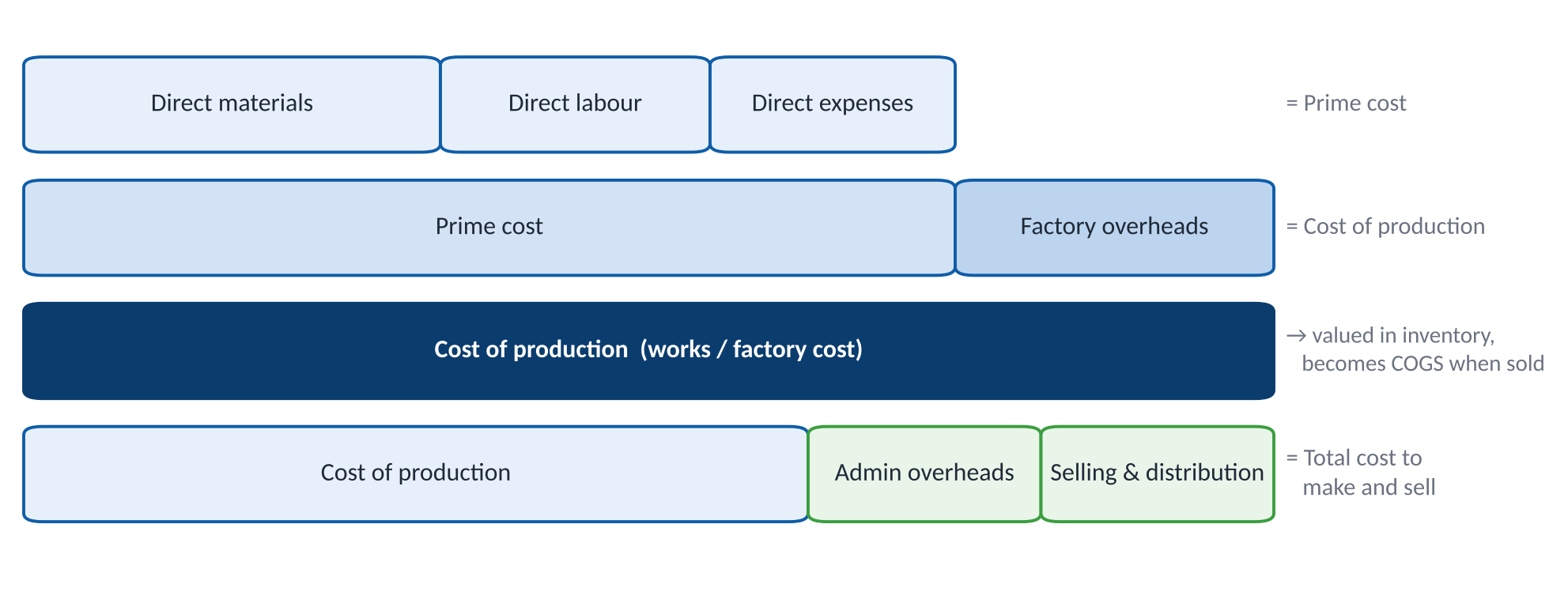
Cost of production is the total expenditure incurred to convert raw materials and components into finished goods ready for sale. It covers everything consumed inside the factory gate:
| Costing Term | What It Includes | Where It Is Used in Business |
|---|---|---|
| Prime Cost | Direct Materials + Direct Labour + Direct Expenses | Fast snapshot of costs directly traceable to each unit produced |
| Conversion Cost | Direct Labour + Factory Overheads | Measuring efficiency of the plant conversion process, independent of fluctuating material prices |
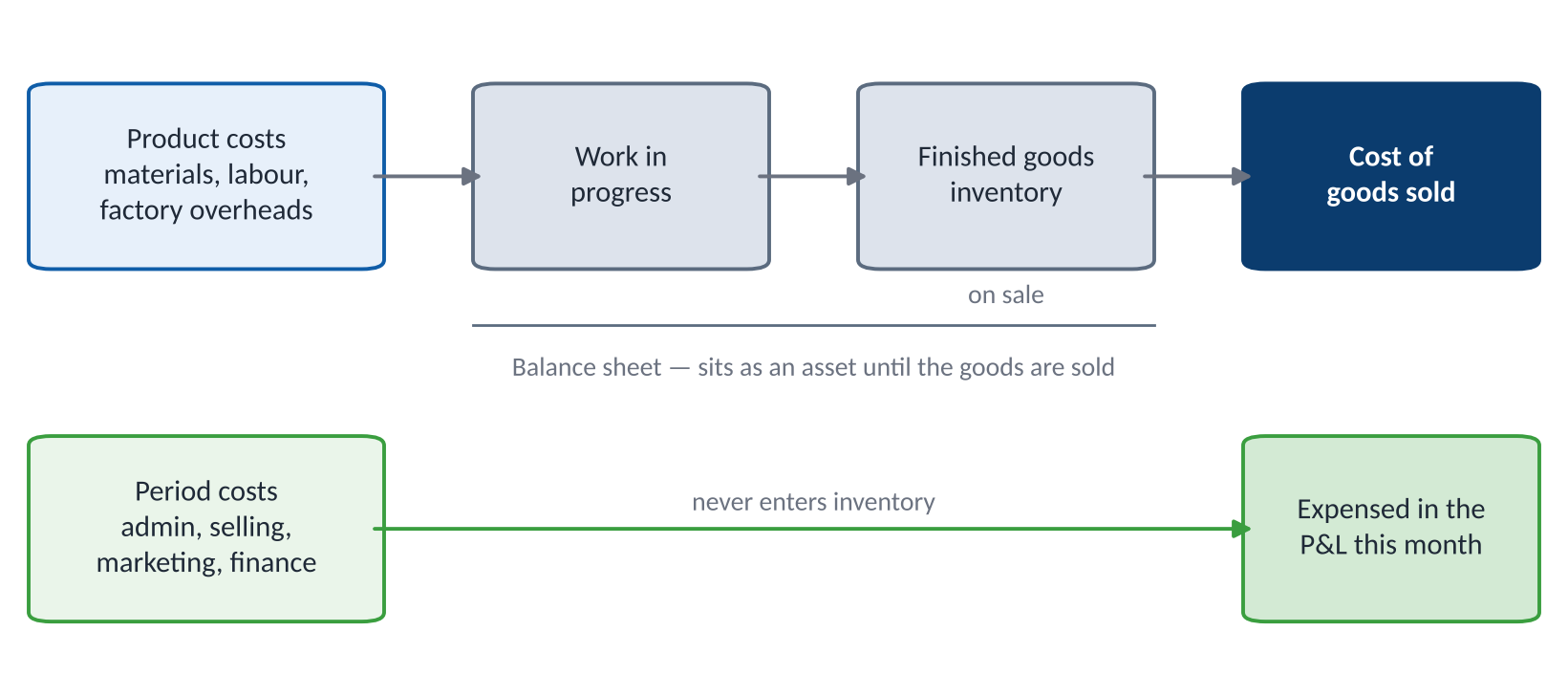
| Cost of Production | Prime Cost + Factory Overheads (+ Opening WIP − Closing WIP − Scrap Credit) | Inventory valuation on balance sheet, product costing, minimum pricing floor |
| Cost of Goods Sold (COGS) | Cost of Production of goods sold (+ Opening FG − Closing FG) | Profit & loss statement; gross margin calculation |
| Total Cost of Sales | Cost of Production + Admin Overheads + Selling & Distribution | Enterprise net margin, comprehensive commercial pricing strategy |
The Building Blocks of Cost of Production
The cleanest way to understand cost of production is to build it up layer by layer, following the logic of the Cost Accounting Standards (CAS-4):
1. Direct Materials at Landed Cost
Resin, steel, milk, titanium dioxide, additives. Must include landed costs (freight inward, insurance, non-creditable customs) minus trade discounts. Excludes recoverable input GST.
2. Direct Labour & Contract Shift Crew
Wages and benefits for line operators, assemblers, and packers. In Indian plants, contract labour paid per shift behaves as a variable cost.
3. Direct Traceable Expenses
Specific job-work charges (electroplating, heat treatment), per-unit royalties, or dedicated mould hire charges traceable to one job.
4. Factory Overheads (Shared Plant Costs)
Plant power, machine depreciation, maintenance spares, factory rent, supervisor salaries, and QC lab operations absorbed via work-centre rates.
The Cost of Production Formula
At its simplest, total cost is fixed plus variable costs. For accurate unit costing, cost accountants divide by good output produced, not units started:
The 10 Types of Production Cost
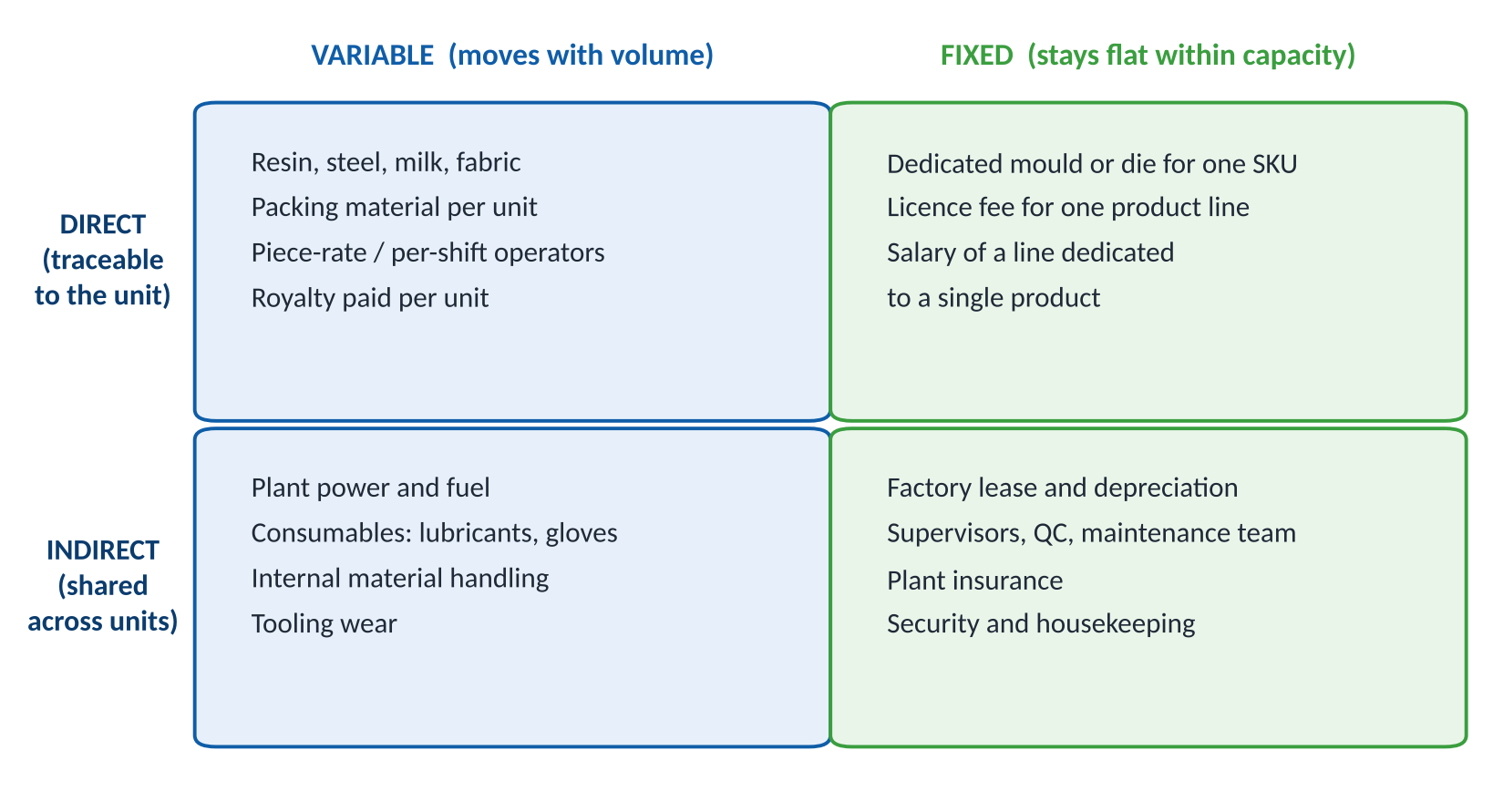
Cost behaviour (fixed vs. variable) tells you what happens when volume shifts. Traceability (direct vs. indirect) tells you how cleanly costs assign to SKUs:
Volume Sensitivity Simulator
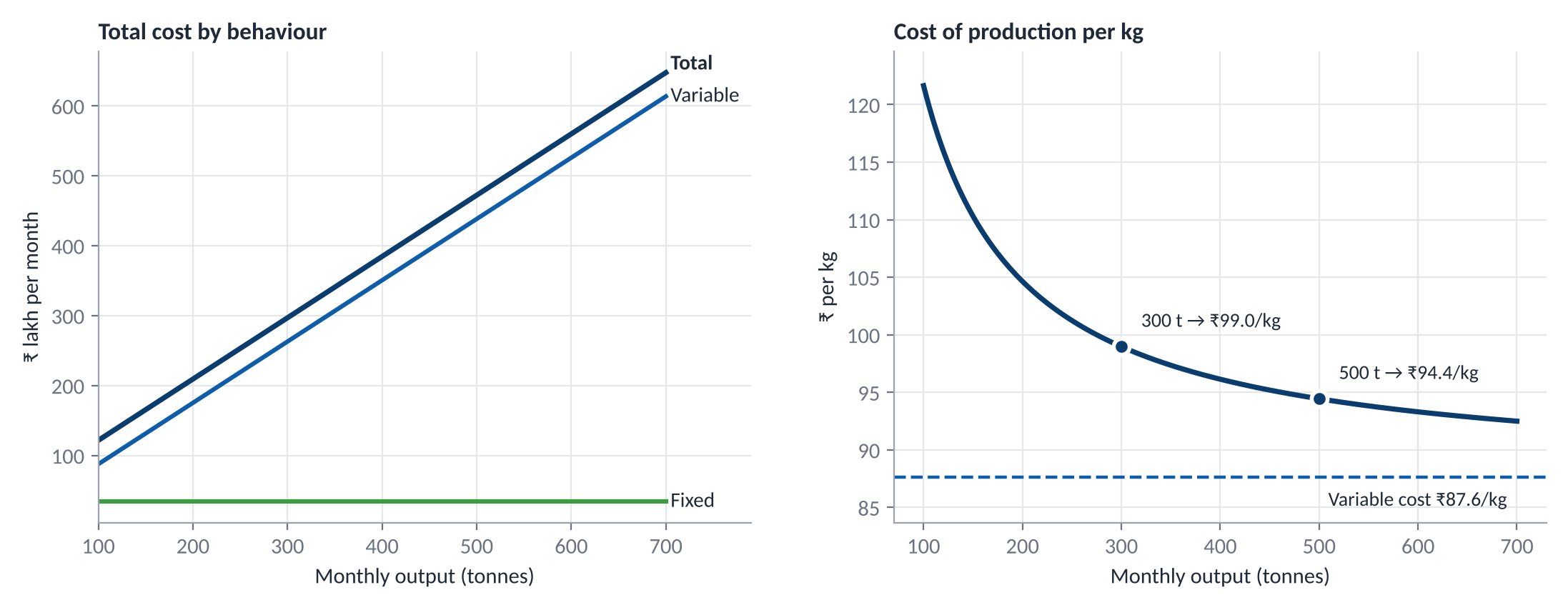
Drag the monthly production slider to witness how fixed plant overheads (₹34 Lakh/mo) dilutes across volume while variable costs remain pegged at ₹87.64/kg.
Worked Example 1: Monthly Cost of Production for a PVC Pipe Plant
Prixgen has implemented ERP for more than ten PVC pipe and polymer manufacturers. Below is a real-world model for an extrusion plant producing 500 tonnes/month:
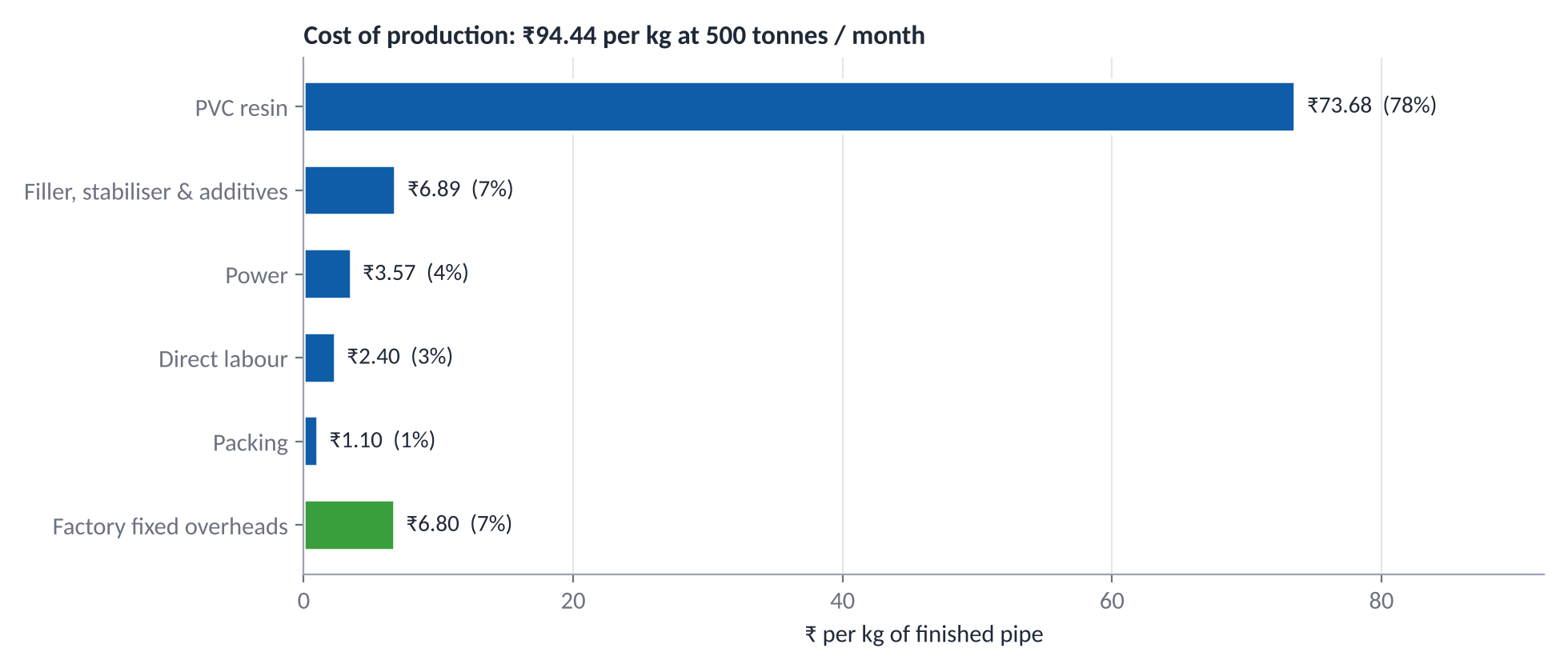
| Cost Head | ₹ Lakh / Month | ₹ / kg | % of Production Cost |
|---|---|---|---|
| Direct Materials (Resin + Additives + 1.5% Net Loss) | 402.84 | 80.57 | 85.3% |
| Extrusion Power (0.42 kWh/kg × ₹8.50) | 17.85 | 3.57 | 3.8% |
| Direct Labour (Contract Operators per shift) | 12.00 | 2.40 | 2.5% |
| Packing Consumables (Sockets, Rings, Ink, Caps) | 5.50 | 1.10 | 1.2% |
| TOTAL VARIABLE PRODUCTION COST | 438.19 | 87.64 | 92.8% |
| Factory Lease & Shed Depreciation | 6.00 | 1.20 | 1.3% |
| Supervisory, QC & Maintenance Salaries | 9.50 | 1.90 | 2.0% |
| Machine Depreciation (Extruders, Dies, Mixers) | 14.00 | 2.80 | 3.0% |
| AMC, Tooling Spares & Routine Repairs | 3.00 | 0.60 | 0.6% |
| Plant & Fire Insurance | 1.50 | 0.30 | 0.3% |
| TOTAL COST OF PRODUCTION | 472.19 | 94.44 | 100.0% |
Marginal Cost & The Bulk-Order Trap
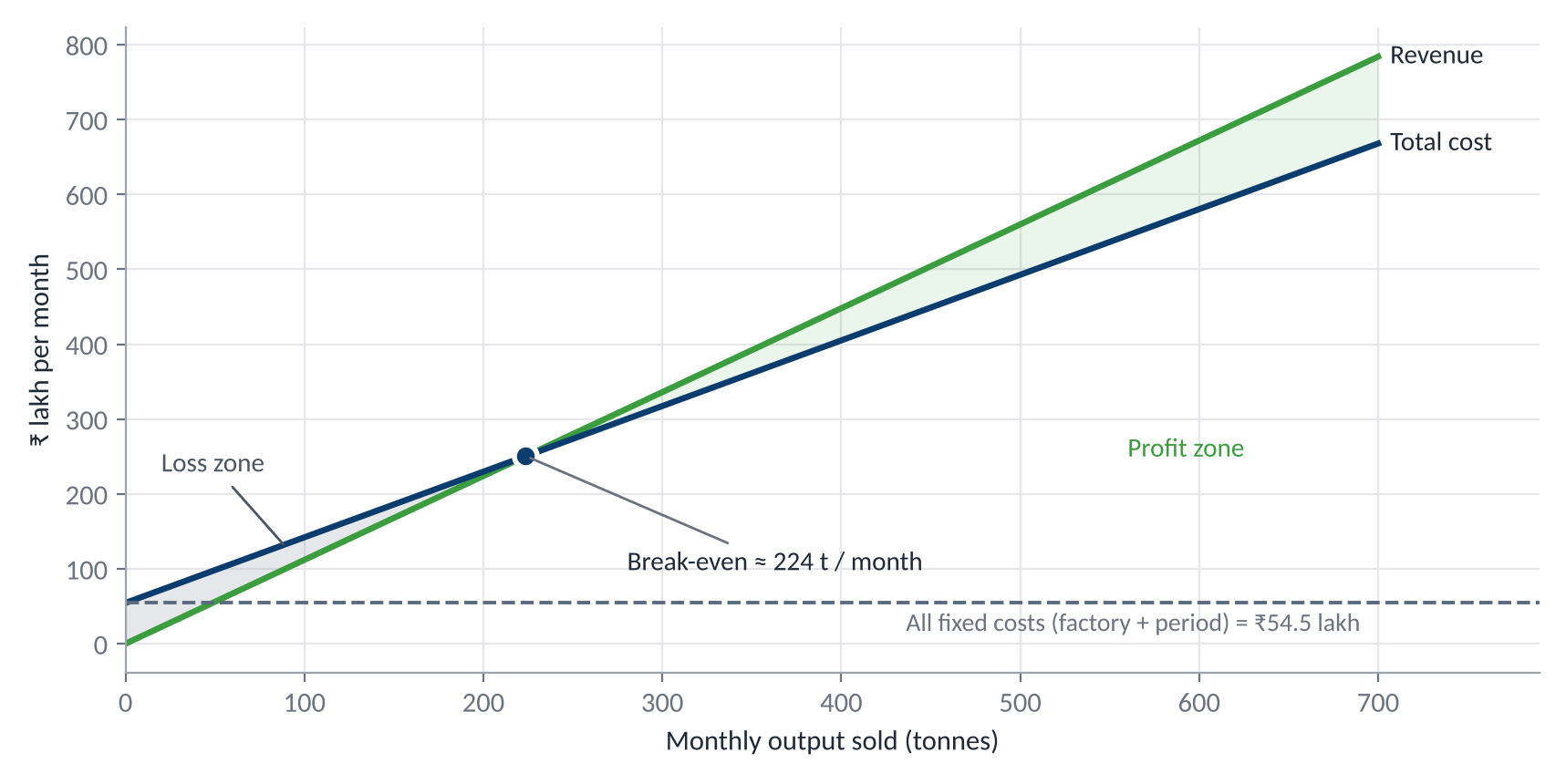
A customer offers ₹95/kg for a 50-tonne bulk order. Your sales head sees an average cost of ₹94.44 and wants to accept. Are you making money or losing money?
Worked Example 2: Batch Costing in a Paint / Chemical Plant
In paints, chemicals, and pharmaceuticals, costs are tracked per batch. Two factors dictate accuracy: productive machine-hour rates and yield loss.
Deriving the High-Speed Disperser Hourly Rate
The disperser incurs ₹2.60 Lakh monthly fixed overheads (depreciation, maintenance, space, supervision). After cleaning and color changeovers, it delivers 230 productive hours (not 720 calendar hours):
| Batch Cost Element | Quantity | Rate (₹) | Total Amount (₹) |
|---|---|---|---|
| Titanium Dioxide (TiO2) | 380 kg | 265.00 | 1,00,700 |
| Acrylic Binder Emulsion | 520 kg | 145.00 | 75,400 |
| Extenders, Biocide & Dispersing Additives | 315 kg | — | 24,370 |
| Water & In-process Solvent | 820 kg | 2.20 | 1,805 |
| Direct Materials & Formulation Subtotal | 2,035 kg | — | 2,02,275 |
| High-Speed Disperser Processing | 3.5 hrs | 1,450.00 | 5,075 |
| Filling & Packaging Line | 2.0 hrs | 880.00 | 1,760 |
| Direct Line Labour & Batch QC Verification | 14 hrs + QC | — | 6,440 |
| 5-Litre Containers, Lids & Barcoded Labels | 390 nos | 92.00 | 35,880 |
| TOTAL BATCH COST | — | — | ₹2,53,595 |
Good output after 2.5% loss (tank hold-up, filter cleanings, QC samples) is 1,950 litres. Cost per litre is ₹130.05. If the cost sheet divided by the planned 2,000 litres, cost would falsely show as ₹126.80 — understated by ₹3.25 a litre. Across annual production, that discrepancy destroys profit.
How to Reduce Your Cost of Production: Ten Proven Levers
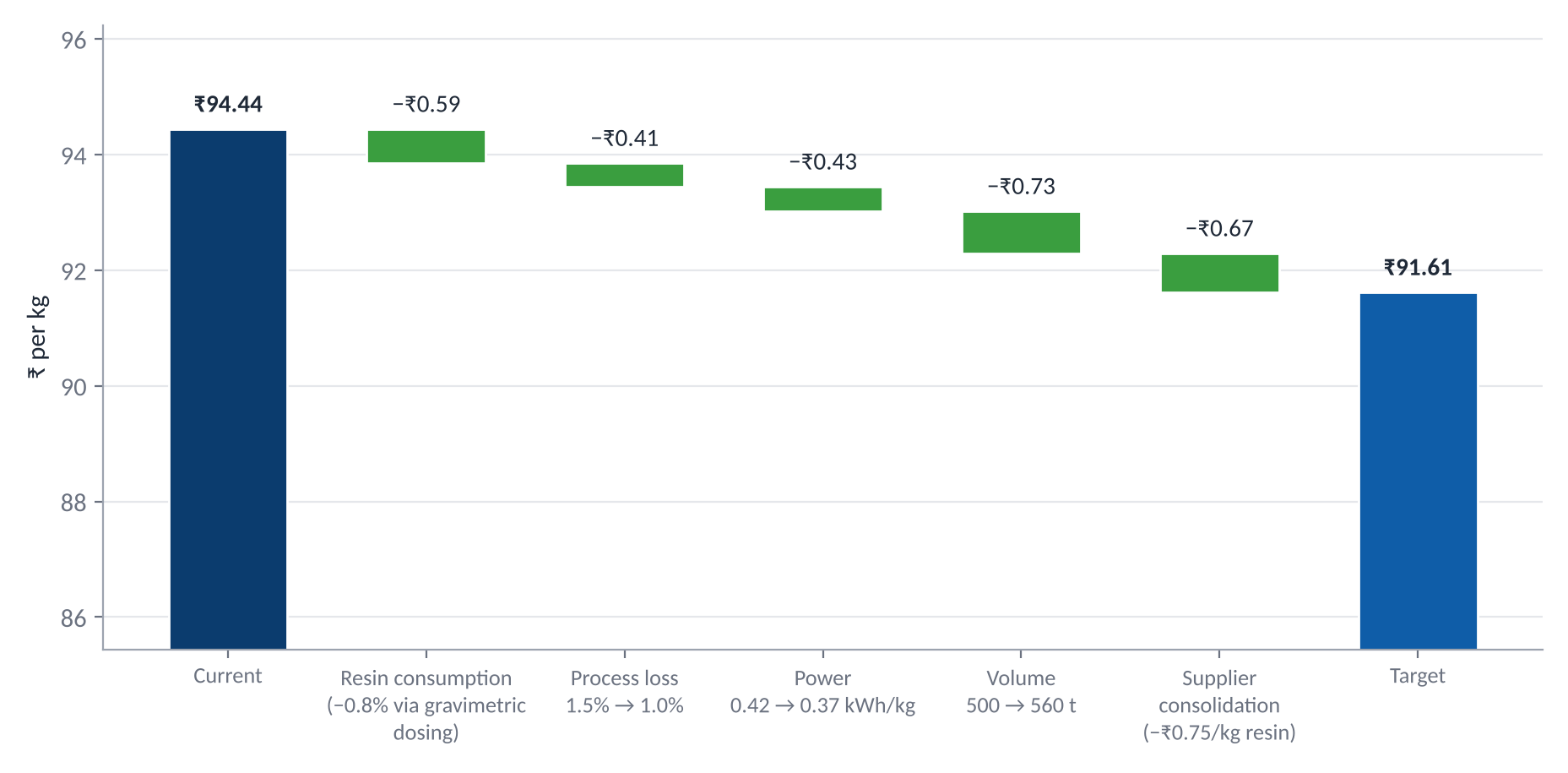
Ranked by size of financial impact based on Prixgen's shop-floor manufacturing engagements:
Engineer Formulation & BOM
Review wall thickness tolerances and substitute costly additives with quality validation.
Measure & Improve Yield
Process loss falling from 1.5% to 1.0% saves ₹25 Lakh a year at 500 tonnes/month.
Consolidate Strategic Suppliers
Earn volume tier discounts and negotiate formula pricing tied to commodity indices.
Cut Energy Cost Per Unit
Sub-meter major extrusion lines; track kWh per kg KPI rather than lump-sum electric bills.
Raise OEE (Overall Equipment Effectiveness)
Eliminate downtime with quick-changeover SMED techniques for tooling and dies.
Condition-Based Maintenance
Trigger preventive maintenance based on actual running hours via machine IoT integration.
Optimise Floor Layout
Position raw material stores adjacent to extruders to eliminate wasteful forklift mileage.
Build Quality In, Not Inspect Out
Use statistical process control at early blending rather than scraping finished rejected pipes.
Right-Size RM & WIP Inventory
Deploy MRP and lead-time reorder points to cut holding charges without stock-outs.
Fill Capacity Profitably
Use marginal costing to accept incremental volume without eroding the master price list.
How an Integrated ERP Delivers True Cost of Production
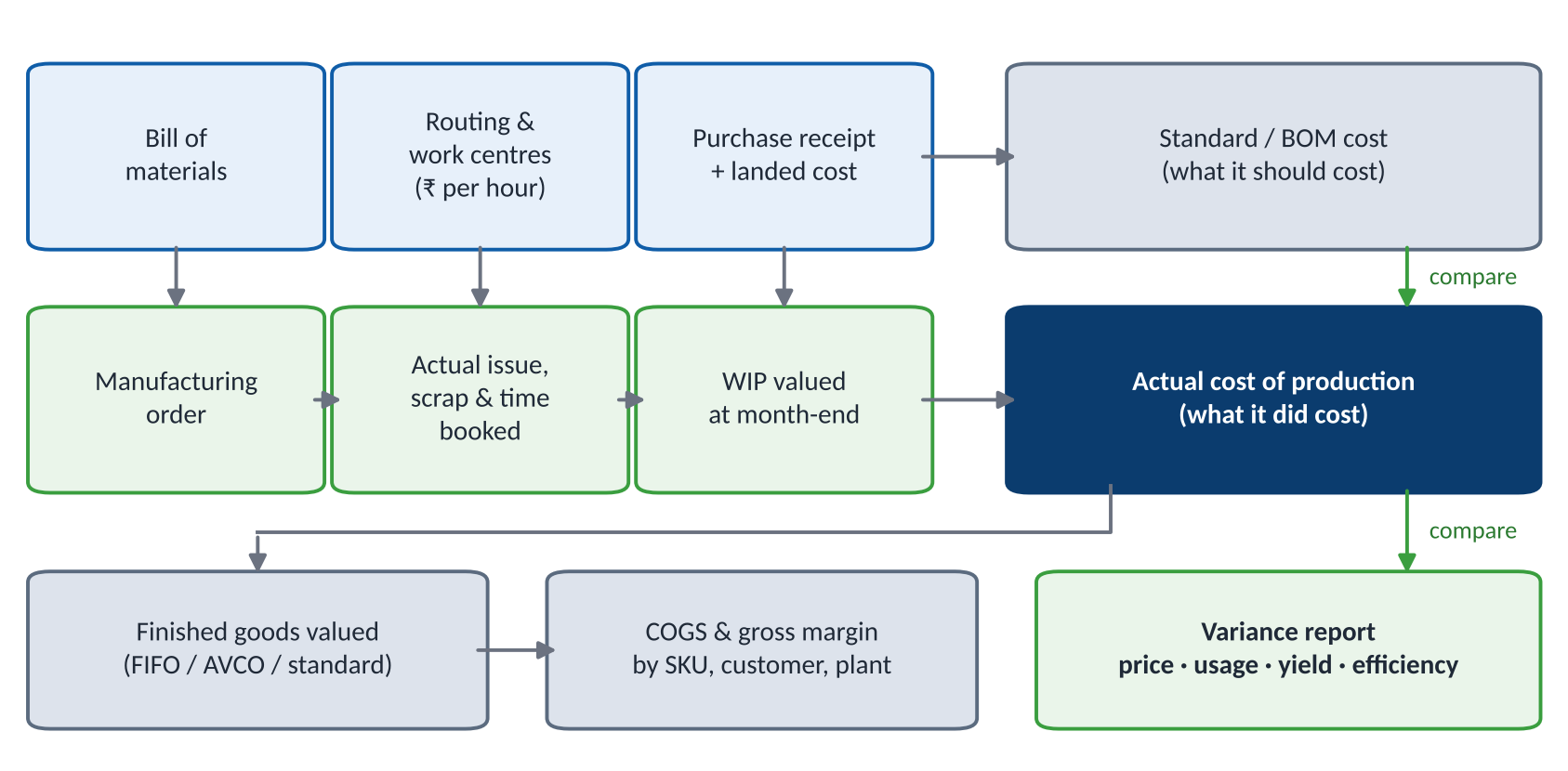
Spreadsheets can compute a static cost sheet. What they cannot do is keep it accurate, order by order, as resin prices move, machine speeds fluctuate, and scrap rises.
6 Critical Questions to Ask Any ERP Partner Before Implementing:
- 1Will my product cost include machine and labour overheads through work-centre hourly rates, or only raw materials?
- 2How will scrap, regrind, by-products and net yield be recorded on the physical shop floor, and by whom?
- 3How will import landed costs (ocean freight, customs, port handling) be captured and allocated across shipments?
- 4Which inventory valuation method (FIFO, AVCO, Standard) will each product category use, and why?
- 5Will I get price, usage, and efficiency variances by order and product family without manual month-end spreadsheets?
- 6Who in my team will own cost-master maintenance after go-live, and how often will machine rates be reviewed?
A Practical 90-Day Roadmap to a Reliable Cost of Production
The proven 4-phase rollout methodology Prixgen uses with manufacturing enterprises:
Phase 1: Baseline
Map product families, process flows, and cost centres. Collect 3–6 months of actual consumption, output, scrap, power, and overhead ledger data.
Phase 2: Master Data
Validate BOM formulations against shop-floor trials. Define routings and work centres. Derive productive machine-hour and labour rates.
Phase 3: Transactions
Enable real-time material issue, scrap, by-product, and time recording on orders. Configure landed costs and automated inventory valuation.
Phase 4: Control
Set standards, launch variance reporting (price, usage, efficiency), assign operational owners, and formalise monthly costing reviews.
Frequently Asked Questions
Know Your True Cost of Production Down to the Rupee
Prixgen Tech Solutions is an Odoo Gold Partner headquartered in Mysuru, with 100+ ERP implementations across 18+ industries, including 10+ PVC & polymer processors, paints, chemicals, and precision manufacturing.